Derivative

2000010805

Level: 
C
A flywheel rotates such that it sweeps out an angle at the rate of \[ \varphi = 4t^2, \] where an angle \(\varphi\) is measured in radians and time \(t\) is measured in seconds. At what time is instantaneous angular velocity of the flywheel equal to \(36\,\frac{\mathrm{rad}}{s}\)? (Hint: Instantaneous angular velocity can be expressed as the derivative of the function \(\varphi(t)\) with respect to time: \(\omega(t)=\frac{\mathrm{d}\varphi}{\mathrm{d}t}\).)
\( 4.5 \,\mathrm{s}\)
\( 3\,\mathrm{s}\)
\( 288 \,\mathrm{s}\)
\( 9 \,\mathrm{s}\)

2000010804

Level: 
C
For a given object to move with uniform acceleration, the engine must perform work that is related with time by the formula \[ W=3t^2, \] where work \(W\) is measured in joules and time \(t\) is measured in seconds. Determine the instantaneous engine power at time \(t=4\,\mathrm{s}\). (Hint: Instantaneous power of a given object can be expressed as the derivative of work function with respect to time: \(P(t)=\frac{\mathrm{d}W}{\mathrm{d}t}\).)
\( 24 \,\mathrm{W}\)
\( 48 \,\mathrm{W}\)
\( 8 \,\mathrm{W}\)
\( 12 \,\mathrm{W}\)

2000010803

Level: 
C
Given the position-versus-time graph (in black) of an object in motion and the tangent line to the graph at the time point of \(10\) seconds (in red), find the instantaneous velocity of this object at \(10\) seconds. (Hint: Instantaneous velocity can be expressed as the derivative of position function with respect to time: \(v(t)=\frac{\mathrm{d}s}{\mathrm{d}t}\).)
\( 2 \,\frac{\mathrm{m}}{\mathrm{s}}\)
\( 0.5 \,\frac{\mathrm{m}}{\mathrm{s}}\)
\( 1 \,\frac{\mathrm{m}}{\mathrm{s}}\)
\( 30\,\frac{\mathrm{m}}{\mathrm{s}}\)

2000010802

Level: 
C
Consider non-uniform motion of an object whose position as a function of time is given by \[ s=t^3-t^2+\frac12 t, \] where time \(t\) is measured in seconds and position \(s\) is measured in meters. Find the instantaneous acceleration of the object at time \(t = 2\) s. (Hint: Instantaneous acceleration can be expressed as the derivative of the velocity function with respect to time and since velocity is the derivative of position function, instantaneous acceleration is its second derivative: \(a(t)=\frac{\mathrm{d}v}{\mathrm{d}t}=\frac{\mathrm{d}^2s}{\mathrm{d}t^2}\).)
\( 10 \,\frac{\mathrm{m}}{\mathrm{s}^2}\)
\( 10.5 \,\frac{\mathrm{m}}{\mathrm{s}^2}\)
\( 8.5 \,\frac{\mathrm{m}}{\mathrm{s}^2}\)
\( 5\,\frac{\mathrm{m}}{\mathrm{s}^2}\)

2000010801

Level: 
C
Consider non-uniform motion of an object whose position as a function of time is given by \[ s=12t-\frac12 t^2, \] where time \(t\) is measured in seconds and position \(s\) is measured in meters. Find the instantaneous velocity of the object at \(8\) seconds. (Hint: Instantaneous velocity can be expressed as the derivative of position function with respect to time: \(v(t)=\frac{\mathrm{d}s}{\mathrm{d}t}\).)
\( 4 \,\mathrm{m}/\mathrm{s}\)
\( 64\, \mathrm{m}/\mathrm{s}\)
\( 8\,\mathrm{m}/\mathrm{s}\)
The object will be at rest at this moment (\( v=0\, \mathrm{m}/\mathrm{s}\)).

2010005203

Level: 
A
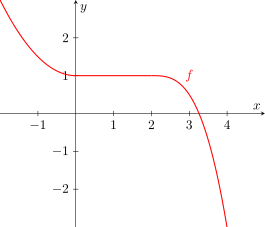
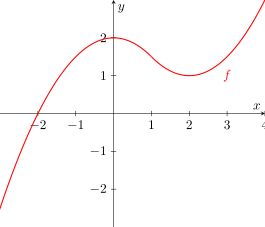
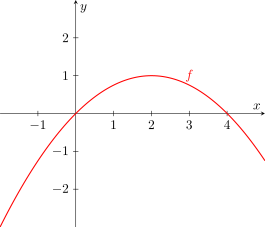
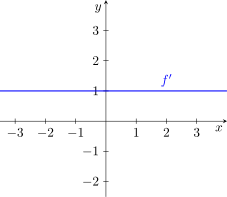
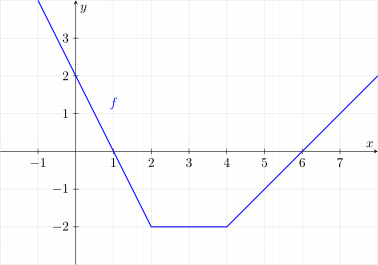
The graph of \( f \) is given in the figure. Which of the following holds? (\( f' \) is the derivative of the function \( f \).)
\( f'(0)=-2 \), \( f'(2) \) does not exist, \( f'(5)=1 \)
\( f'(0)=-2 \), \( f'(2)=0 \), \( f'(5)=1 \)
\( f'(1)=0 \), \( f'(3)=0 \), \( f'(4) \) does not exist
\( f'(1)=-1 \), \( f'(3)=0 \), \( f'(4)=0 \)