Derivative

1103164705

Level: 
A
The graph of \( f \) is given in the figure. Which of the following holds? (\( f' \) is the derivative of the function \( f \).)
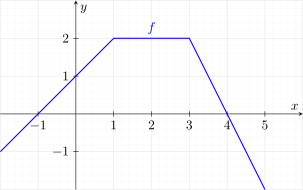
\( f'(-1)=1 \), \( f'(2)=0 \), \( f'(4)=-2 \)
\( f'(-1)=1 \), \( f'(2)=2 \), \( f'(4)=0 \)
\( f'(-1)=0 \), \( f'(2)=0 \), \( f'(4)=-2 \)
\( f'(-1)=0 \), \( f'(2)=2 \), \( f'(4)=0 \)
\( f'(-1)=1 \), \( f'(2)=0 \), \( f'(4)=0 \)
1103164704

Level: 
A
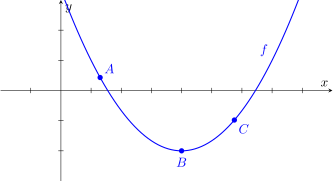
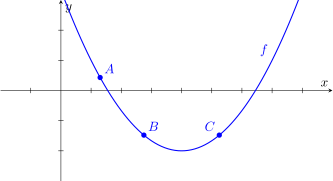
The graph of \( f \) is given in the figure, where \( A \), \( B \) and \( C \) are points of the graph, and \( y \)-coordinate of the point \( B \) is the minimum value of the function \( f \). If \( x_A \), \( x_B \) and \( x_C \) denote the \( x \)-coordinates of the points \( A \), \( B \) and \( C \), and if \( f' \) is the derivative of \( f \), then:
\( f'( x_A ) < 0 \), \( f'( x_B ) = 0 \), \( f'( x_C ) > 0 \)
\( f'( x_A ) < 0 \), \( f'( x_B ) = 0 \), \( f'( x_C ) < 0 \)
\( f'( x_A ) > 0 \), \( f'( x_B ) < 0 \), \( f'( x_C ) < 0 \)
\( f'( x_A ) > 0 \), \( f'( x_B ) = 0 \), \( f'( x_C ) > 0 \)

1103164703

Level: 
A
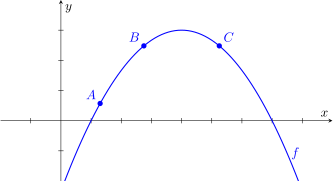
The graph of \( f \) is given in the figure, where \( A \), \( B \) and \( C \) are points on the graph. If \( x_A \), \( x_B \) and \( x_C \) denote the \( x \)-coordinates of the points \( A \), \( B \) and \( C \) and if \( f' \) is the derivative of \( f \), then:
\( f'( x_A ) < f'( x_B ) < f'( x_C ) \)
\( f'( x_A ) < f'( x_B ) = f'( x_C ) \)
\( f'( x_A ) > f'( x_B ) = f'( x_C ) \)
\( f'( x_A ) > f'( x_B ) > f'( x_C ) \)
\( f'( x_A ) = f'( x_B ) < f'( x_C ) \)

1103164702

Level: 
A
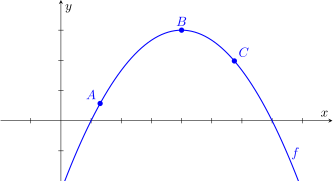
The graph of \( f \) is given in the figure, where \( A \), \( B \) and \( C \) are points on the graph and \( y \)-coordinate of the point \( B \) is the maximum value of the function \( f \). If \( x_A \), \( x_B \) and \( x_C \) denote the \( x \)-coordinates of the points \( A \), \( B \) and \( C \), and if \( f' \) is the derivative of \( f \), then:
\( f'( x_A ) > 0 \), \( f'( x_B ) = 0 \), \( f'( x_C ) < 0 \)
\( f'( x_A ) > 0 \), \( f'( x_B ) > 0 \), \( f'( x_C ) < 0 \)
\( f'( x_A ) < 0 \), \( f'( x_B ) = 0 \), \( f'( x_C ) < 0 \)
\( f'( x_A ) < 0 \), \( f'( x_B ) = 0 \), \( f'( x_C ) > 0 \)

1103164701

Level: 
A
The graph of \( f \) is given in the figure, where \( A \), \( B \) and \( C \) are points on the graph. If \( x_A \), \( x_B \) and \( x_C \) denote the \( x \)-coordinates of the points the \( A \), \( B \) and \( C \), and if \( f' \) is the derivative of \( f \), then:
\( f'( x_A ) > f'( x_B ) > f'( x_C ) \)
\( f'( x_A ) < f'( x_B ) = f' ( x_C ) \)
\( f'( x_A ) > f'( x_B ) = f'(x_C ) \)
\( f'(x_A ) < f'( x_B ) < f'( x_C ) \)
\( f'( x_A ) = f'( x_B ) > f'( x_C ) \)

1003230206

Level: 
B
Which of the statements A, B, C, D given bellow are incorrect? \[ \begin{array}{l} \text{A: }\left(\ln\frac x2\right)'=\frac1x,\ x\in\mathbb{R}^+ \\ \text{B: }\left(5\sin⁡3x\right)'=5\cos⁡3x \\ \text{C: }\left(\frac1{\left(x^3-1\right)^2}\right)'=\frac{-6x^2}{\left(x^3-1\right)^3},\ x\in\mathbb{R}\setminus\{1\} \\ \text{D: }\left(\ln⁡(1+\cos⁡ x ) \right)'=\frac1{1-\sin ⁡x},\ x\neq\frac{\pi}2+2k\pi,\ k\in\mathbb{Z} \end{array}\] The only incorrect statements are:
B, D
A, B, D
B, C
B
A, C
A, C, D

1003230205

Level: 
B
Which of the statements A, B, C given bellow are correct? \[ \begin{array}{l} \text{A: } \left(\frac{2x-1}{2-x}\right)'=\frac{5-4x}{(2-x)^2},\ x\neq2 \\ \text{B: } \left(\frac{\mathrm{e}^x-1}{x}\right)'=\frac{\mathrm{e}^x(x-1)-1}{x^2},\ x\neq0 \\ \text{C: } \left(\frac{\cos⁡ x}{1-\sin ⁡x}\right)'=\frac1{1-\sin ⁡x},\ x\neq\frac{\pi}2+2k\pi,\ k\in\mathbb{Z} \end{array}\] The only correct statements are:
C
A, C
A, B
B
A
B, C

1003230204

Level: 
B
Which of the statements A, B, C given bellow are correct? \[ \begin{array}{l} \text{A: }\left(\frac1{x^3}\cdot\cos ⁡x\right)' =-\frac{\cos x+\sin ⁡x}{x^4},\ x\in\mathbb{R}\setminus\{0\} \\ \text{B: }\bigl(\left(1-x^3\right)\cdot\ln x \bigr)'=-3x^2\ln x+\frac1x - x^2,\ x\in\mathbb{R}^+ \\ \text{C: } \left(5^x\cdot\sqrt[5]x\right)'=5^{x-1}\sqrt[5]x\left(5\ln⁡5+\frac1x\right),\ x\in\mathbb{R}\setminus\{0\} \end{array} \] The only correct statements are:
B, C
A, C
A, B
B
A
C

1003230203

Level: 
B
Given the function \( f(x)=\frac{\sqrt x}{\ln ⁡x} \), find the set of all \( x \), \( x\in\mathbb{R} \), for which \( f'(x)=0 \).
\( \left\{ \mathrm{e}^2 \right\} \)
\( \{ \mathrm{e} \} \)
\( \left\{ \sqrt{\mathrm{e}} \right\} \)
\( \left\{ \frac1{\mathrm{e}};\mathrm{e} \right\} \)
\( \{ 2 \} \)
\( \left\{ 1;\mathrm{e}^2 \right\} \)