C

9000028408

Część: 
C
Find the condition which is equivalent to the fact that the equation \(ax^{2} + bx + c = 0\) with \(x\in \mathbb{R}\) and real coefficients \(a\), \(b\), \(c\) has two real solutions and one of the solutions is bigger than the other one.
\(b^{2} - 4ac > 0\text{ and }a\not = 0\)
\(b^{2} - 4ac\not = 0\text{ and }a\not = 0\)
\(- \frac{b} {2a} > \frac{\sqrt{b^{2 } -4ac}} {2a} \)
\(- \frac{b} {2a} < \frac{\sqrt{b^{2 } -4ac}} {2a} \)

9000028407

Część: 
C
Find the condition which is equivalent to the fact that the equation \(ax^{2} + bx + c = 0\) with \(x\in \mathbb{R}\) and real coefficients \(a\), \(b\), \(c\) has a unique positive and a unique negative real solution.
\(b^{2} - 4ac > 0\text{ and }\frac{c} {a} < 0\)
\(b^{2} - 4ac > 0\text{ and } - \frac{b} {2a} < 0\)
\(\left (\frac{c} {a} < 0\right )\text{ and }\left (\frac{b} {a} > 0\right )\)
\(\left (\frac{c} {a} < 0\right )\text{ and }\left (\frac{b} {a} < 0\right )\)

9000028406

Część: 
C
Find the condition which is equivalent to the fact that the equation \(ax^{2} + bx + c = 0\) with \(x\in \mathbb{R}\) and real coefficients \(a\), \(b\), \(c\) has a solution in a form of a pair of two opposite real nonzero numbers.
\(\frac{c} {a} < 0\text{ and }b = 0\)
\(- \frac{b} {2a} = 0\)
\(b^{2} = 4ac\text{ and }a\not = 0\)
\(b^{2} = 4ac\text{ and }a\not = 0\text{ and }c\not = 0\)

9000028403

Część: 
C
Find the condition which is equivalent to the fact that the equation \(ax^{2} + bx + c = 0\) with \(x\in \mathbb{R}\) and real coefficients \(a\), \(b\), \(c\) has two real solutions \(x_{1}\neq x_{2}\), \(x_{1} > 0\), \(x_{2} > 0\).
\(b^{2} - 4ac > 0\text{ and }\frac{c} {a} > 0\text{ and }\frac{b} {a} < 0\)
\(a\not = 0\text{ and }c > 0\)
\(a > 0\text{ and }b < 0\text{ and }c > 0\text{ and }b^{2} - 4ac > 0\)
\(a\not = 0\text{ and }c > 0\text{ and }b^{2} - 4ac > 0\)

9000028402

Część: 
C
Find the condition which is equivalent to the fact that the equation \(ax^{2} + bx + c = 0\) with \(x\in \mathbb{R}\) and real coefficients \(a\), \(b\), \(c\) has two real solutions satisfying \(x_{1} = 0\) and \(x_{2}\neq 0\).
\(c = 0\text{ and }a\not = 0\text{ and }b\not = 0\)
\((a = b = 0)\text{ and }c\not = 0\)
\(a\not = 0\text{ and }c = 0\)
\(b\not = 0\text{ and }c = 0\)

9000028401

Część: 
C
Find the condition which is equivalent to the fact that the equation \(ax^{2} + bx + c = 0\) with \(x\in \mathbb{R}\) and real coefficients \(a\), \(b\), \(c\) has at least one real solution.
\((b^{2} - 4ac\geq 0\text{ and }a\not = 0)\text{ or }(a = 0\text{ and }b\not = 0)\text{ or }(a = b = c = 0)\)
\(a\not = 0\text{ and }b^{2} - 4ac\geq 0\)
\(b^{2} - 4ac\leq 0\)
\((b^{2} - 4ac\geq 0\text{ and }a\not = 0)\text{ or }(a = 0)\text{ or }(b = 0)\)

9000026007

Część: 
C
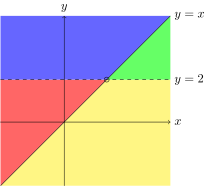
Który układ nierówności odpowiada zbiorowi przedstawionemu na rysunku poniżej?
\(\begin{aligned}y & < 2 & \\y + 1&\geq x + 1 \\ \end{aligned}\)
\(\begin{aligned}y &\geq 2 & \\y + 1& < x + 1 \\ \end{aligned}\)
\(\begin{aligned}y & > 2 & \\y + 1&\leq x + 1 \\ \end{aligned}\)
\(\begin{aligned}y&\leq 2 & \\y& > x \\ \end{aligned}\)

9000026008

Część: 
C
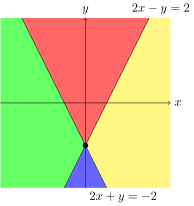
Który układ nierówności odpowiada zbiorowi przedstawionemu na rysunku poniżej?
\(\begin{aligned}2x - y&\leq 2 & \\2x + y&\geq - 2 \\ \end{aligned}\)
\(\begin{aligned}2x - y&\geq 2 & \\2x + y&\geq - 2 \\ \end{aligned}\)
\(\begin{aligned}2x - y&\leq 2 & \\2x + y&\leq - 2 \\ \end{aligned}\)
\(\begin{aligned}2x - y&\geq 2 & \\2x + y&\leq - 2 \\ \end{aligned}\)

9000026009

Część: 
C
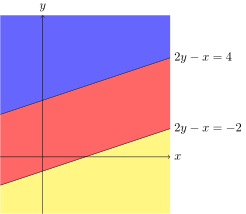
Który układ nierówności odpowiada zbiorowi przedstawionemu na rysunku poniżej?
\(\begin{aligned}2y -\phantom{ 2}x& < 4& \\x - 2y & < 2 \\ \end{aligned}\)
\(\begin{aligned}2y -\phantom{ 2}x& < 4& \\x - 2y & > 2 \\ \end{aligned}\)
\(\begin{aligned}2y - x& > 4 & \\2y - x& < -2 \\ \end{aligned}\)
\(\begin{aligned}2y - x& > 4 & \\2y - x& > -2 \\ \end{aligned}\)

9000026010

Część: 
C
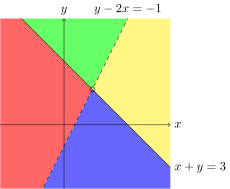
Który układ nierówności odpowiada zbiorowi przedstawionemu na rysunku poniżej?
\(\begin{aligned}x &\leq 3 & \\5x& < 9 - 3y \\ \end{aligned}\)
\(\begin{aligned}x & < 3 & \\5x& < 9 - 3y \\ \end{aligned}\)
\(\begin{aligned}x & > 3 & \\5x& < 9 - 3y \\ \end{aligned}\)
\(\begin{aligned}x &\leq 3 & \\5x& > 9 - 3y \\ \end{aligned}\)