Points and vectors

1103024308

Level: 
A
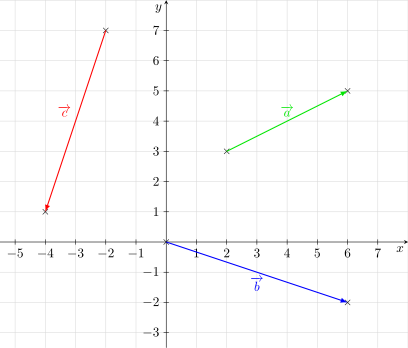
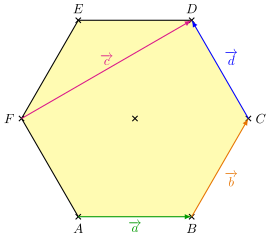
Given the vectors \( \overrightarrow{a} \), \( \overrightarrow{b} \), and \( \overrightarrow{c} \) shown in the picture, express the vector \( \overrightarrow{c} \) as a linear combination of vectors \( \overrightarrow{a} \) and \( \overrightarrow{b} \).
\( \overrightarrow{c} = -2\overrightarrow{a} + \overrightarrow{b} \)
\( \overrightarrow{c} = -\overrightarrow{a} + \frac12\overrightarrow{b} \)
\( \overrightarrow{c} = -\frac32\overrightarrow{a} + \overrightarrow{b} \)
\( \overrightarrow{c} = -2\overrightarrow{a} + \frac32\overrightarrow{b} \)

1003024307

Level: 
A
Let \( \overrightarrow{a} = (-1;2) \), \( \overrightarrow{b} = (2;1) \), \( \overrightarrow{c} = (-4;3) \). Express vector \( \overrightarrow{c} \) as a linear combination of vectors \( \overrightarrow{a} \) and \( \overrightarrow{b} \).
\( \overrightarrow{c} = 2\overrightarrow{a} - \overrightarrow{b} \)
\( \overrightarrow{c} = 4\overrightarrow{a} - 8\overrightarrow{b} \)
\( \overrightarrow{c} = 4\overrightarrow{a} - \overrightarrow{b} \)
\( \overrightarrow{c} = -2\overrightarrow{a} + \overrightarrow{b} \)

1003024306

Level: 
A
We are given the points A = [-4;2;3], B = [-5;6;3], D = [1;1;4]. Find the coordinates of a point \( C \), if: \[ \overrightarrow{u} = \overrightarrow{AB}\text{, }\ \overrightarrow{CD} = -\frac12\overrightarrow{u}\]
\( C = \left[\frac12; 3; 4\right] \)
\( C = \left[-\frac12;-3;-4\right] \)
\( C = \left[\frac32;3;4\right] \)
\( C = \left[\frac32;-3;-4\right] \)

1103024305

Level: 
A
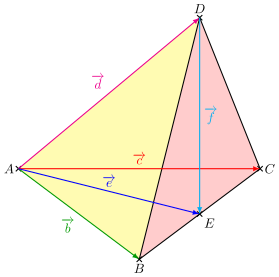
In a tetrahedron \( ABCD \), let \( \overrightarrow{b} = \overrightarrow{AB} \), \( \overrightarrow{c} = \overrightarrow{AC} \), \( \overrightarrow{d} = \overrightarrow{AD} \), \( \overrightarrow{e} = \overrightarrow{AE} \) and \( \overrightarrow{f} = \overrightarrow{DE} \). Further let \( E \) be the midpoint of \( BC \). Express vectors \( \overrightarrow{e} \) and \( \overrightarrow{f} \) as a linear combination of vectors \( \overrightarrow{b} \), \( \overrightarrow{c} \), \( \overrightarrow{d} \).
\( \overrightarrow{e} = \frac12\overrightarrow{b} + \frac12\overrightarrow{c};\ \overrightarrow{f} = \frac12\overrightarrow{b} + \frac12\overrightarrow{c} - \overrightarrow{d} \)
\( \overrightarrow{e} = \frac12\overrightarrow{b} + \frac12\overrightarrow{d};\ \overrightarrow{f} = \overrightarrow{b} + \overrightarrow{c} + \overrightarrow{d} \)
\( \overrightarrow{e} = \overrightarrow{b} + \overrightarrow{c};\ \overrightarrow{f} =\frac12\overrightarrow{b} + \frac12\overrightarrow{c} - \overrightarrow{d} \)
\( \overrightarrow{e} = \frac12\overrightarrow{b} + \frac12\overrightarrow{c};\ \overrightarrow{f} = \frac12\overrightarrow{b} + \frac12\overrightarrow{c} + \overrightarrow{d} \)

1103024304

Level: 
A
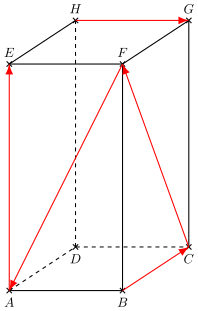
The picture shows a rectangular cuboid \( ABCDEFGH \). In the cuboid find the vector that is the sum of \( \overrightarrow{BC} + \overrightarrow{AE} + \overrightarrow{CF} + \overrightarrow{FA} + \overrightarrow{HG} \).
\( \overrightarrow{BF} \)
\( \overrightarrow{BE} \)
\( \overrightarrow{BG} \)
\( \overrightarrow{BH} \)

1103024303

Level: 
A
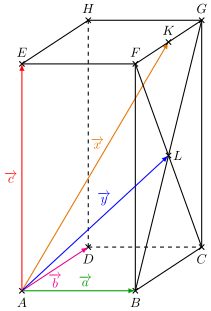
The picture shows a rectangular cuboid \( ABCDEFGH \) with \( \overrightarrow{a} = \overrightarrow{AB} \), \( \overrightarrow{b} = \overrightarrow{AD} \), \( \overrightarrow{c} = \overrightarrow{AE} \), \( \overrightarrow{x} = \overrightarrow{AK} \) and \( \overrightarrow{y} = \overrightarrow{AL} \). Point \( K \) is the midpoint of \( FG \) and point \( L \) is the centre of face \( BCGF \). Express vectors \( \overrightarrow{x} \) and \( \overrightarrow{y} \) as a linear combination of vectors \( \overrightarrow{a} \), \( \overrightarrow{b} \), \( \overrightarrow{c} \).
\( \overrightarrow{x} = \overrightarrow{a} + \frac12\overrightarrow{b} + \overrightarrow{c};\ \overrightarrow{y} = \overrightarrow{a} + \frac12\overrightarrow{b} + \frac12\overrightarrow{c} \)
\( \overrightarrow{x} = \frac12\overrightarrow{a} + \overrightarrow{b} + \frac12\overrightarrow{c};\ \overrightarrow{y} = \overrightarrow{a} - \frac12\overrightarrow{b} + \frac12\overrightarrow{c} \)
\( \overrightarrow{x} = \overrightarrow{a} + \frac12\overrightarrow{b} + \frac12\overrightarrow{c};\ \overrightarrow{y} = \overrightarrow{a} - \frac12\overrightarrow{b} + \frac12\overrightarrow{c} \)
\( \overrightarrow{x} = \overrightarrow{a} + \frac12\overrightarrow{b} + \frac12\overrightarrow{c};\ \overrightarrow{y} = \frac12\overrightarrow{a} + \frac12\overrightarrow{b} + \frac12\overrightarrow{c} \)

1103024302

Level: 
A
In a regular hexagon \( ABCDEF \) shown in the picture, let \( \overrightarrow{a} = \overrightarrow{AB} \), \( \overrightarrow{b} = \overrightarrow{BC} \), \( \overrightarrow{c} = \overrightarrow{FD} \) and \( \overrightarrow{d} = \overrightarrow{CD} \). Express vectors \( \overrightarrow{c} \) and \( \overrightarrow{d} \) as a linear combination of vectors \( \overrightarrow{a} \) and \( \overrightarrow{b} \).
\( \overrightarrow{c} = \overrightarrow{a} + \overrightarrow{b};\ \overrightarrow{d} = \overrightarrow{b} - \overrightarrow{a} \)
\( \overrightarrow{c} = 2\overrightarrow{a} + 2\overrightarrow{b};\ \overrightarrow{d} = 2\overrightarrow{b} - 0.5\overrightarrow{a} \)
\( \overrightarrow{c} = 2\overrightarrow{a} + \overrightarrow{b};\ \overrightarrow{d} = \overrightarrow{b} - \overrightarrow{a} \)
\( \overrightarrow{c} = \overrightarrow{a} + \overrightarrow{b};\ \overrightarrow{d} = \overrightarrow{a} - \overrightarrow{b} \)

1103024301

Level: 
A
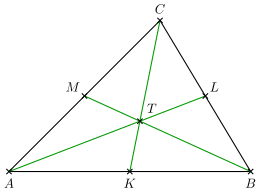
In a triangle \( ABC \), let \( K \), \( L \) and \( M \) be the midpoints of \( AB \), \( BC \) and \( AC \) consecutively and let \( T \) be the centroid of \( ABC \). Find the values of coefficients \( k \), \( l \) and \(m \) if: \[ \overrightarrow{TM} = k\cdot\overrightarrow{BT};\ \overrightarrow{ML} = l\cdot\overrightarrow{BA};\ \overrightarrow{CK} = m\cdot\overrightarrow{TC} \]
\( k=\frac12;\ l=-\frac12 ;\ m=-\frac32 \)
\( k=\frac12;\ l=\frac12;\ m=-\frac32 \)
\( k=\frac12 ;\ l=-\frac12 ;\ m=-\frac23 \)
\( k=\frac12;\ l=-\frac12;\ m=\frac32 \)

1103021001

Level: 
B
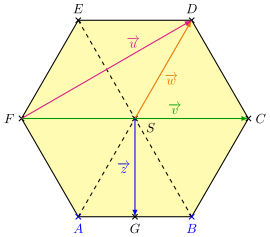
Let \( ABCDEF \) be a regular hexagon with the centre \( S \) and the side of length \( 3\,\mathrm{cm}\). The point \( G \) is the midpoint of the segment \( AB \). The vectors \( \overrightarrow{u} \), \( \overrightarrow{v} \), \( \overrightarrow{w} \), \( \overrightarrow{z} \) are indicated in the hexagon shown in the picture. Find the dot product of: \( \overrightarrow{v}\cdot\overrightarrow{w} \), \( \overrightarrow{v}\cdot\overrightarrow{z} \) and \( \overrightarrow{v}\cdot\overrightarrow{u} \).
\( \overrightarrow{v}\cdot\overrightarrow{w}=9 \), \( \overrightarrow{v}\cdot\overrightarrow{z} = 0 \), \( \overrightarrow{v}\cdot\overrightarrow{u}=27 \)
\( \overrightarrow{v}\cdot\overrightarrow{w}=9 \), \( \overrightarrow{v}\cdot\overrightarrow{z} = 0 \), \( \overrightarrow{v}\cdot\overrightarrow{u}=9\sqrt6 \)
\( \overrightarrow{v}\cdot\overrightarrow{w}=\frac92 \), \( \overrightarrow{v}\cdot\overrightarrow{z} = 0 \), \( \overrightarrow{v}\cdot\overrightarrow{u}=9\sqrt6 \)
\( \overrightarrow{v}\cdot\overrightarrow{w}=\frac92 \), \( \overrightarrow{v}\cdot\overrightarrow{z} = 1 \), \( \overrightarrow{v}\cdot\overrightarrow{u}=27 \)

1103030705

Level: 
A
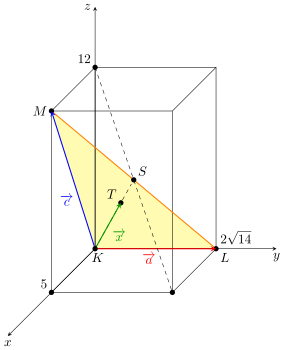
Let there be a triangle KLM and vectors \( \overrightarrow{a} \), \( \overrightarrow{c} \) in the coordinate system. Triangle \( KLM \) and vectors \( \overrightarrow{a} \), \( \overrightarrow{c} \) are given in the coordinate system shown in the picture. Point T is the centroid of the triangle KLM. Express vector \( \overrightarrow{x} \), where \( \overrightarrow{x}=\overrightarrow{KT} \) as a linear combination of \( \overrightarrow{a} \) and \( \overrightarrow{c} \) and evaluate \( \left|\overrightarrow{x}\right| \).
\( \overrightarrow{x}=\frac13 \overrightarrow{a}+\frac13 \overrightarrow{c} \), \( \left|\overrightarrow{x}\right|=5 \)
\( \overrightarrow{x}=\frac23 \overrightarrow{a}+\frac23 \overrightarrow{c} \), \( \left|\overrightarrow{x}\right|=10 \)
\( \overrightarrow{x}=\frac12 \overrightarrow{a}+\frac12 \overrightarrow{c} \), \( \left|\overrightarrow{x}\right|=\frac{15}2 \)
\( \overrightarrow{x}=\frac14 \overrightarrow{a}+\frac14 \overrightarrow{c} \), \( \left|\overrightarrow{x}\right|=\frac{225}{12} \)