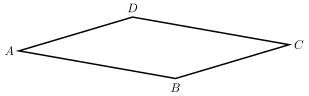
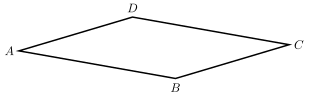
Consider a parallelogram \(ABCD\)
with \(A = [1,3]\),
\(B = [2,-1]\) and
\(C = [5,1]\). Let
\(S\) be the center of
the diagonal \(BD\).
Find the vector \(\overrightarrow{AS } \).
Given points \(A = [1,2]\)
and \(B = [4,4]\), find the
point \(X\) on the
\(x\)-axis such that
the distance from \(X\)
to \(B\) is a double of
the distance from \(X\)
to \(A\).
Find all solutions of the problem.
Among vectors \(\vec{u} = \left (- \frac{2}
{\sqrt{2}},2\sqrt{2}\right )\),
\(\vec{v} = (-5,10)\),
\(\vec{w} = (2.5,-5)\),
\(\vec{r} = (-3.5,6)\)
find the vector which is not parallel to the vector
\(\vec{a} = (1,-2)\).
In the following list identify a pair of points
\(C\),
\(D\) such that the
vector \(\overrightarrow{CD } \) is not
equal to the vector \(\overrightarrow{AB } \)
where \(A = [1,3,-2]\)
and \(B = [-2,4,3]\).