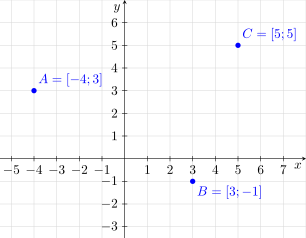
Find the coordinates of the midpoints of the line segments \( AB \), \( BC \), \( AC \). For coordinates of the points \( A \), \( B \) and \( C \), see the picture.
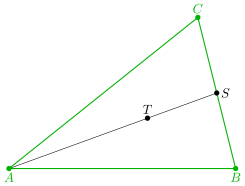
Let \( ABC \) be a triangle. In the picture, the midpoint of the side \( BC \) and the centroid of the triangle are indicated. Out of the following vector relations select the one that is not true.
Let \( \vec{a}=(3,-5) \) and \( \vec{b}=(6,-10) \). Find all the vectors \( \vec{c} \) such that
\[ \vec{a}\cdot\vec{c}=11\ \text{ and }\ \vec{b}\cdot\vec{c}=22\text{ .} \]
Let \( \vec{a}=(2,- 3) \) and \( \vec{b}=(3,-2) \). Find all the vectors \( \vec{c} \) such that
\[ \vec{a}\cdot\vec{c}=8\ \text{ and }\ \vec{b}\cdot\vec{c}=27. \]
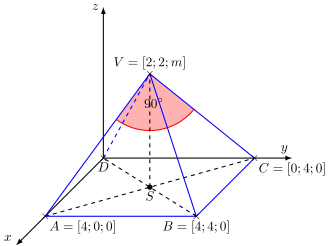
Let \( ABCDV \) be a right pyramid with a square base, such that its opposite edges contain a right angle (see the picture).
Specify the missing coordinate of the apex \( V \).
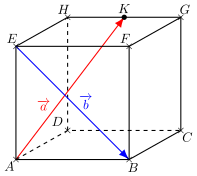
In the cube \( ABCDEFGH \) find the angle \( \varphi \) between the vectors \( \vec{b}=\overrightarrow{EB} \) and \( \vec{a}=\overrightarrow{AK} \), where \( K \) is the midpoint of \( HG \). Round \( \varphi \) to the nearest degree.
Help: Choose the appropriate coordinate system.
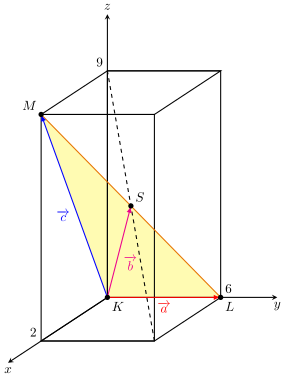
The picture shows the triangle \( KLM \) with indicated vectors \( \vec{a} \), \( \vec{b} \), \( \vec{c} \) in a coordinate system. What are the vector coordinates \( \vec{b} \)? Express \( \vec{b} \) as a linear combination of \( \vec{a} \) and \( \vec{c} \).
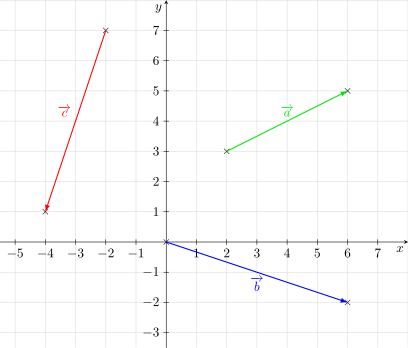
Given the vectors \( \vec{a} \), \( \vec{b} \), \( \vec{c} \) shown in the picture, express a vector \( \vec{b} \) as a linear combination of vectors \( \vec{a} \) and \( \vec{c} \).