C

1103148603

Level: 
C
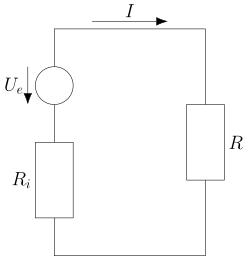
Consider a simple circuit in which a battery of electromotive force \( U_e \) and internal resistance \( R_i \) drives a current \( I \) through an external resistor of resistance \( R \) (see figure). The external resistor could be for example an electric light, an electric heating element, or, maybe, an electric motor. The basic purpose of the circuit is to transfer energy from the battery to the external resistor, where it actually does something useful for us (e.g. lighting a light bulb, or lifting a weight). \[ \] The power \( P \) transferred to the external resistor is described by the formula \( P=U_eI-R_i I^2 \). What maximum power can be transferred to the external resistor if we have the source with \( R_i=0.25\,\Omega \) and \( U_e=20\,\mathrm{V} \)?
\( 400\,\mathrm{W} \)
\( 80\,\mathrm{W} \)
\( 40\,\mathrm{W} \)
\( 790\,\mathrm{W} \)

1003148602

Level: 
C
Consider an object thrown at an angle of \( 30^{\circ} \) above the horizontal with the initial velocity of \( 40\frac{\mathrm{m}}{\mathrm{s}} \). How long does it take for the object to reach its maximum height? \[ \] Note: The height \( y \) of an object thrown is described by the formula \( y=v_0t\sin\alpha-\frac12gt^2 \), where \( v_0 \) is the initial velocity, \( g \) is gravitational acceleration (count with the rounded value \( 10\frac{\mathrm{m}}{\mathrm{s}^2}\)), \( t \) is the time period of the object motion in seconds, and \( \alpha \) is the angle to the horizontal at which the object is thrown.
\( 2\,\mathrm{s} \)
\( 4\,\mathrm{s} \)
\( 8\,\mathrm{s} \)
\( 1\,\mathrm{s} \)

1003148601

Level: 
C
Consider an object thrown upwards from the ground with the initial velocity of \( 30\frac{\mathrm{m}}{\mathrm{s}} \). The object moves upwards with decreasing vertical velocity until it stops. Then it starts moving vertically downwards. Find the greatest height above the ground the object does reach. \[ \] Note: The vertical distance \( y \) of a thrown object is described by the equation \( y=v_0t-\frac12gt^2 \), where \( v_0 \) is the initial velocity of the thrown object, \( g \) is gravitational acceleration (count with the rounded value \( 10\frac{\mathrm{m}}{\mathrm{s}^2}\)), and \( t \) is the time period of the object motion in seconds.
\( 45\,\mathrm{m} \)
\( 135\,\mathrm{m} \)
\( 360\,\mathrm{m} \)
\( 40\,\mathrm{m} \)

1003177803

Level: 
C
Choose the domain of the expression. \[ \frac1{\sqrt{|3x-9|-\sqrt2}} \]
\( \left(-\infty,3-\frac{\sqrt2}3\right)\cup\left(3+\frac{\sqrt2}3,\infty\right) \)
\( \left(-\infty,-3-\frac{\sqrt2}3\right)\cup\left(3+\frac{\sqrt2}3,\infty\right) \)
\( \left(-\infty,-3+\frac{\sqrt2}3\right)\cup\left(3+\frac{\sqrt2}3,\infty\right) \)
\( \left(-\infty,-3-\frac{\sqrt2}3\right)\cup\left(-3+\frac{\sqrt2}3,\infty\right) \)

1003158902

Level: 
C
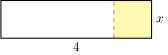
The length of a rectangle is \( 4\,\mathrm{cm} \) and width is \( x\,\mathrm{cm} \). The rectangle is divided by vertical crossing line into two parts so that one part is a square with the side of \( x\,\mathrm{cm} \) (see the picture). What is the maximum area of the remaining part of the rectangle?
\( 4\,\mathrm{cm}^2 \)
\( 2\,\mathrm{cm}^2 \)
\( 16\,\mathrm{cm}^2 \)
\( 1\,\mathrm{cm}^2 \)

1003158901

Level: 
C
An object is moving with a constant deceleration in a straight line. Displacement \( s \) (in metres) in time \( t \) (in seconds) is modelled by \( s=24t-3t^2 \). Find the displacement of the object from the moment it starts to decelerate until it stops.
\( 48\,\mathrm{m} \)
\( 144\,\mathrm{m} \)
\( 16\,\mathrm{m} \)
\( 96\,\mathrm{m} \)