The graph of a linear function \( f \) passes through the point \( \left[4\sqrt3,2\right] \) and it makes an angle of \( 30^{\circ} \) with the positive direction of \( x \)-axis measured anticlockwise. Choose the correct form of the function \( f \), such that the given property is preserved.
Suppose \( f \) is a linear function. If the value of the independent variable \( x \) increases by \( 4 \), the function value decreases by \( 12 \). Choose the correct form of the function \( f \), such that the given property is preserved.
Suppose \( f \) is a linear function. If the value of the independent variable \( x \) increases by \( 6 \), the function value increases by \( 18 \). Choose the correct form of the function \( f \), such that the given property is preserved.
Find all \( t \), \( t\in\mathbb{R} \), such that the following equation with the variable \( x \) has more than two solutions.
\[ \Bigl| |3-x|-3\Bigr|=t \]
Choose the triple of points, such that the graph of any of the functions \( f(x)=ax^2+c \), where \( a\in\mathbb{R}\setminus{0} \), \( c\in\mathbb{R} \), does not pass through all three points.
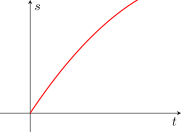
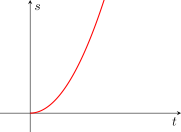
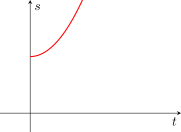
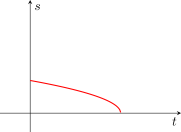
If an object moving with an initial velocity \( v_0 \) is slowing down at a constant deceleration \( a \), then the distance \( s \) travelled while decelerating is described by the formula \( s=v_0t-\frac12at^2 \), where \( t \) is time of decelerating. Choose the graph, which could represent the dependency of the distance \( s \) on the time \( t \).
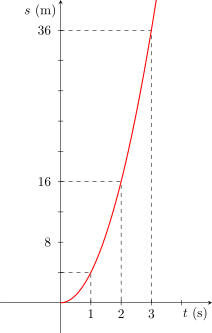
Suppose, an object, that is in rest, starts to accelerate with the constant acceleration \( a \). The distance \( s \) travelled by the object in time \( t \) is given by the formula \( s=\frac12at^2 \). You can see the graph of the distance \( s \) on the time \( t \) dependency in the picture. Find the acceleration \( a \) of the object.