C

1103171503

Level: 
C
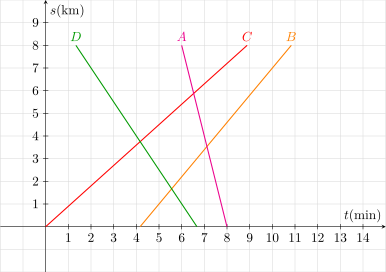
Trains run between the towns \( M \) and \( N \) in both directions. The lines in the distance-time diagram correspond to the uniform movements of trains \( A \), \( B \), \( C \) and \( D \) between the towns. Find out which of the trains is the fastest. \[ \] Note: The distance-time diagram as seen in the picture is a graphical representation of trains operating schedule for a certain rout (or routs). Connections are displayed as broken-lines or line segments in rectangular coordinate system, where horizontal is the time axis with the time during an operating day and vertical is the distance axis with distances of the traffic nodes (e.g. railroad stations, cities) from one chosen reference node (in our case the town \( N \)). Connections in one direction (from \( N \) to \( M \)) are displayed by the lines skewed to the right (trains \( B \) and \( C \)) and back-connections in other direction (from \( M \) to \( N \)) are displayed by the lines skewed to the left (trains \( A \) and \( D \)).
\( A \)
\( B \)
\( C \)
\( D \)
1103171501

Level: 
C
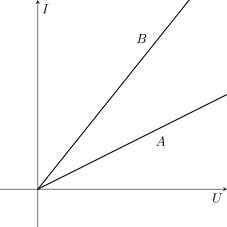
Ohm's law states that the current \( I \) through a conductor is directly proportional to the voltage \( U \) between the endpoints of the conductor. This relationship is described by the equation \( I=\frac UR \), where \( R \) is the resistance of the conductor. Current-voltage characteristics of the conductors \( A \) and \( B \) are in the picture. Which of the conductors has greater resistance?
\( A \)
\( B \)
Both conductors have the same resistance.
It is not possible to answer the question based on the graph.

1003076909

Level: 
C
\( ABC \) is a triangle. Given \( |AB|=3\,\mathrm{cm} \), the measure of \( \measuredangle CAB \) is \( 75^{\circ} \), and the measure of \(\measuredangle ABC \) is \( 45^{\circ} \), calculate the length of the side \( AC \).
\( \sqrt6\,\mathrm{cm} \)
\( 3\sqrt2\,\mathrm{cm} \)
\( 2\sqrt3\,\mathrm{cm} \)
\( 3\frac{\sqrt3}{\sqrt2}\,\mathrm{cm} \)

1103076908

Level: 
C
The area of an obtuse triangle is \( 4\,\mathrm{cm}^2 \) and the lengths of the sides containing the obtuse angle are \( 2\,\mathrm{cm} \) and \( 8\,\mathrm{cm} \). Give the measure of this angle.
\( 150^{\circ} \)
\( 120^{\circ} \)
\( 135^{\circ} \)
\( 105^{\circ} \)

1103076907

Level: 
C
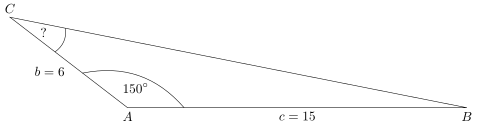
\( ABC \) is a triangle with the sides of lengths \( c=15 \), \( b=6 \), and the measure of \( \measuredangle CAB \) is \( 150^{\circ} \). Which of the numbers gives the size of the angle \( BCA \) most accurately?
\( 21.55^{\circ} \)
\( 11.54^{\circ} \)
\( 5.77^{\circ} \)
\( 9.23^{\circ} \)

1003076906

Level: 
C
The lengths of the sides in a triangle are \( a \), \( b \), \( c \) and the opposite angles are \( \alpha \), \( \beta \), \( \gamma \). Give the measure of \( \alpha \) if \( a^2 = b^2 + c^2 +bc \).
\( 120^{\circ} \)
\( 60^{\circ} \)
\( 30^{\circ} \)
\( 90^{\circ} \)

1103076905

Level: 
C
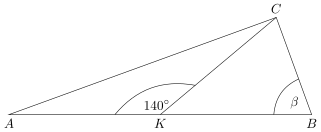
The triangle in the diagram is divided into two isosceles triangles \( AKC \) and \( KBC \) which have the same area. Calculate the size of the angle \( \beta \) if you know that the measure of \(\measuredangle AKC \) is \( 140^{\circ} \).
\( 70^{\circ} \)
\( 60^{\circ} \)
\( 50^{\circ} \)
\( 40^{\circ} \)