C

1103206102

Level: 
C
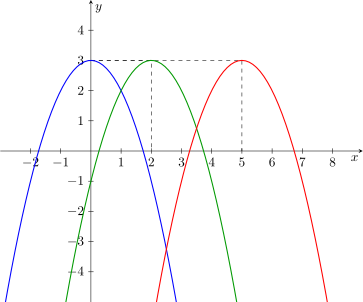
There are graphs of three quadratic functions in the picture. Choose the formula which corresponds to all three functions graphed in the picture.
\( y=-(x+a)^2+3 \), \( a\in(-\infty; 0] \)
\( y=-(x+a)^2+3 \), \( a\in\mathbb{R}^+ \)
\( y=-(x+3)^2+a \), \( a\in\mathbb{R}^+ \)
\( y=-(x-3)^2+a \), \( a\in\mathbb{R}^+ \)

1003171301

Level: 
C
The freezing point and the boiling point of water (both under the normal atmospheric pressure) are the base of the most commonly used temperature scale around Europe. It is Celsius temperature scale in Celsius degrees (\( ^{\circ}\mathrm{C} \)). Fahrenheit temperature scale in Fahrenheit degrees (\( ^{\circ}\mathrm{F} \)) is of general common use in English speaking countries especially in the USA. The basic temperature points in mentioned scales have the values: \[ \begin{array}{l} \text{Water freezing point } \dots\ 0\,^{\circ}\mathrm{C} / 32\,^{\circ}\mathrm{F} \\ \text{Water boiling point } \dots\ 100\,^{\circ}\mathrm{C} / 212\,^{\circ}\mathrm{F} \end{array} \] From the following equations choose the one that can be used to convert a temperature from its Celsius representation to the Fahrenheit value, provided you know that the relationship between the scales is linear. (In equations, \( F \) is a numerical value of a temperature in Fahrenheits and \( C \) is a numerical value of a temperature in Celsius.)

\( F=\frac95 C+32 \)
\( F=\frac59C+32 \)
\( F=\frac59 C-\frac{160}9 \)
\( F=32C+100 \)

1003159201

Level: 
C
The 3D printer prints a solid \( 5 \) centimetre cube in \( 2 \) hours. The printer can print the cube with the maximum edge length of \( 20\,\mathrm{cm} \). Suppose the printing time is directly proportional to the cube volume. Choose the function that describes the dependence of the number \( n \) of cubes printed in \( 1 \) day on the printed cube edge length \( a \), which is specified in centimetres. Neglect time needed for using the printer.
\( n=1500a^{-3};\ a\in(0;20] \)
\( n=60a^{-1};\ a\in(0;20] \)
\( n=300a^{-2};\ a\in(0;20] \)
\( n=2.4a;\ a\in(0;20] \)