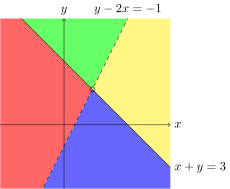
Which part of the plane describes the solution of the following system of
inequalities?
\[\begin{aligned}
x +\phantom{ 3}y\leq &3 & &
\\y - 2x < & - 1 & &
\end{aligned}\]
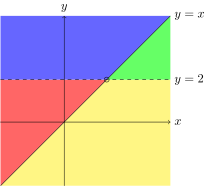
Which part of the plane describes the solution of the following system of
inequalities?
\[\begin{aligned}
x + y > &2 + x & &
\\y + 1\leq &x + 1 & &
\end{aligned}\]
A falling body dropped at a velocity
\(60\, \mathrm{m}\mathrm{s}^{-1}\). Find the
initial height \(h\),
if the relation between the velocity and the initial height
\(h\) is
\(v = \sqrt{2hg}\). Use
\(g = 10\, \mathrm{m}\mathrm{s}^{-2}\) for
acceleration of gravity.
The initial height is between \(150\, \mathrm{m}\)
and \(200\, \mathrm{m}\).
The initial height is smaller than \(100\, \mathrm{m}\).
The initial height is between \(100\, \mathrm{m}\)
and \(150\, \mathrm{m}\).
The initial height is bigger than \(200\, \mathrm{m}\).
A body hangs on a string of the length
\(l_{1}\). The length
\(l\) of the spring
defines the period \(T\)
of motion by the relation
\[
T = 2\pi \sqrt{ \frac{l}
{g}},
\]
where \(g\)
is a standard acceleration of gravity. We have to adjust the length of the string such
that the period doubles. Find the new length of the string.
We elongate the string by \(3\cdot l_{1}\),
i.e. \(l_{2} = l_{1} + 3l_{1}\).
The length doubles, i.e. \(l_{2} = 2l_{1}\).
The new length will be half of the original length, i.e.
\(l_{2} = \frac{1}
{2}l_1\).
We shorten the string by \(3\cdot l_{1}\),
i.e. \(l_{2} = l_{1} - 3l_{1}\).