C

2000006004

Level: 
C
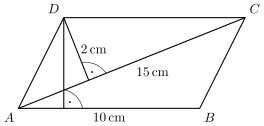
In the parallelogram \(ABCD\), the side \(AB\) is \(10\,\mathrm{cm}\) long, the diagonal \(AC\) measures \(15\,\mathrm{cm}\). The distance of the vertex \(D\) from the diagonal \(AC\) is \(2\,\mathrm{cm}\). What is the distance of the vertex \(D\) from the side \(AB\)?
\(3\,\mathrm{cm}\)
\(4\,\mathrm{cm}\)
\(5\,\mathrm{cm}\)
\(6\,\mathrm{cm}\)

2000005904

Level: 
C
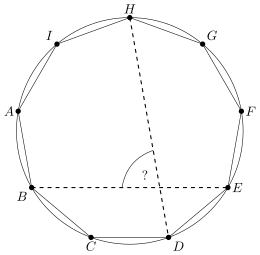
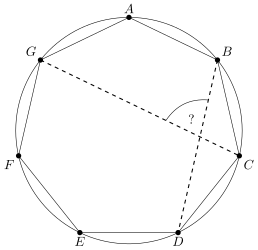
Find the magnitude of the angle that the diagonals \(DB\) and \(CG\) make in the regular heptagon \(ABCDEFG\). (See the picture.)
\( 180^{\circ}-\left(\frac{360^{\circ}}{14} +3\cdot\frac{360^{\circ}}{14}\right)\)
\( 180^{\circ}-\left(\frac{360^{\circ}}{7} +3\cdot\frac{360^{\circ}}{7}\right)\)
\( 180^{\circ}-\frac{360^{\circ}}{14} +3\cdot\frac{360^{\circ}}{14}\)
\( 180^{\circ}-\left(\frac{360^{\circ}}{14} +4\cdot\frac{360^{\circ}}{14}\right)\)

2000005508

Level: 
C
A rectangle with sides \(3\,\mathrm{cm}\) and \(4\,\mathrm{cm}\) long is divided by one of its diagonals into two triangles. What is the distance of the centers of gravity of these two triangles?
\(\frac{5}{3}\,\mathrm{cm}\)
\(\frac{4}{3}\,\mathrm{cm}\)
\(\frac{10}{3}\,\mathrm{cm}\)
\(2\,\mathrm{cm}\)

2000005504

Level: 
C
Let \(ABCD\) be an arbitrary convex quadrilateral and let’s denote by \(P\), \(Q\), \(R\), \(S\) the centers of the sides \(AB\), \(BC\), \(CD\), \(DA\) in that order. Then, what type of a quadrilateral is \(PQRS\)?
It may or may not be a parallelogram.
It is a rectangle.
It is a rectangle or a square.
It is not a parallelogram.