The equation
\[
x^{2} - 2\mathrm{i}x + q = 0
\]
with a parameter \(q\in \mathbb{C}\)
has a solution \(x_{1} = 1 + 2\mathrm{i}\). Find
the second solution \(x_{2}\)
and the parameter \(q\).
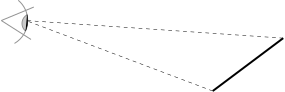
A \(3\, \mathrm{m}\) long
rod is in a slant position with respect to the observer's eye: one end is in the distance
\(20\, \mathrm{m}\) and the
other one \(18\, \mathrm{m}\).
Find the visual angle of the rod (the angle between the lines which connect the
observer's eye and the ends of the rod) and round to the nearest degrees.
Three forces act on the same body in the same point and the total
force on the body is zero (the forces cancel). The first two forces are
\(8\, \mathrm{N}\) and
\(10\, \mathrm{N}\) and the angle between
these forces is \(55^{\circ }\).
Find the third force.
Three forces \(F_{1}\),
\(F_{2}\) and
\(F_{3}\) act on the
same body in the same point and the total force on the body is zero (the forces cancel). The first
two forces are \(F_{1} = 8\, \mathrm{N}\)
and \(F_{2} = 10\, \mathrm{N}\) and the
angle between \(F_{1}\)
and \(F_{2}\) is
\(55^{\circ }\). Find the
angle between \(F_{3}\)
and \(F_{1}\).
Round your answer to the nearest degrees.
Two straight roads go off from the crossing. The angle between directions of the roads is
\(52^{\circ }18'\).
A significant tree is on the first road in the distance
\(250\, \mathrm{m}\) from
the crossing. A rock with a beautiful view is on the second road in the distance
\(380\, \mathrm{m}\) from
the crossing. Find the direct distance (length of a line segment) from the rock to the
tree and round your answer to nearest meters.
Find the values of the parameter \(m\in \mathbb{C}\)
which guarantee that the following quadratic equation has a double solution.
\[
mx^{2} - 2x - 1 + \mathrm{i} = 0
\]
Solve the following equation for \(z\in \mathbb{C}\). By \(\overline{z }\) the complex conjugate of \(z \) is denoted.
\[
3z - 2\overline{z } = 8 - 10\mathrm{i}
\]
One of the roots of the equation \( x^{2} + px - 11 = 0\) with the parameter \(p\in \mathbb{C}\) is \(x_{1} = 3 -\mathrm{i}\sqrt{2}\). Find the second root \(x_{2}\) and the corresponding value of the parameter \(p\).
\(x_{2} = -3 -\mathrm{i}\sqrt{2},\ p = 2\mathrm{i}\sqrt{2}\)
\(x_{2} = 3 + \mathrm{i}\sqrt{2},\ p = 6\)
\(x_{2} = -3 -\mathrm{i}\sqrt{2},\ p = 6\)
\(x_{2} = 3 + \mathrm{i}\sqrt{2},\ p = -2\mathrm{i}\)
\(x_{2} = -3 -\mathrm{i}\sqrt{2},\ p = -2\mathrm{i}\sqrt{2}\)