C

9000038703

Level: 
C
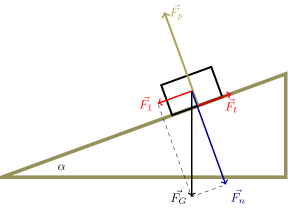
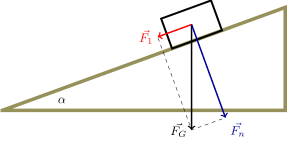
The box is on the slope as in the picture. The angle of the slope is \(\alpha \). The forces acting on the box are the force of gravity \(\vec{F_{G}}\) and the friction \(\vec{F_{t}}\). The force of gravity can be replaced by two components \(\vec{F_{1}}\) and \(\vec{F_{n}}\). (The force \(\vec{F_{1}}\) is parallel to the slope and \(\vec{F_{n}}\) is perpendicular to the slope.) Find \(F_{p}\).
\(F_{p} = F_{G}\cos \alpha \)
\(F_{p} = \frac{F_{G}} {\cos \alpha } \)
\(F_{p} = F_{G}\mathop{\mathrm{tg}}\nolimits \alpha \)
\(F_{p} = \frac{F_{G}} {\mathop{\mathrm{tg}}\nolimits \alpha } \)
\(F_{p} = F_{G}\sin \alpha \)
\(F_{p} = \frac{F_{G}} {\sin \alpha } \)

9000038704

Level: 
C
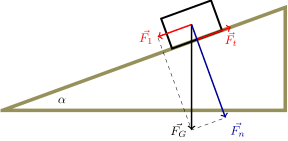
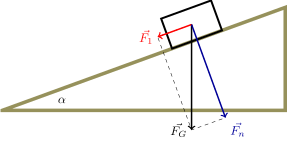
The box is on the slope as in the picture. The angle of the slope is \(\alpha \). The forces acting on the box are the force of gravity \(\vec{F_{G}}\) and the friction \(\vec{F_{t}}\). The force of gravity can be replaced by two components \(\vec{F_{1}}\) and \(\vec{F_{n}}\). (The force \(\vec{F_{1}}\) is parallel to the slope and \(\vec{F_{n}}\) is perpendicular to the slope.) For \(F_{1} = 20\, \mathrm{N}\) and \(F_{n} = 55\, \mathrm{N}\) find the corresponding \(\alpha \).
\(\alpha \doteq 20^{\circ }\)
\(\alpha \doteq 21^{\circ }\)
\(\alpha \doteq 69^{\circ }\)
\(\alpha \doteq 70^{\circ }\)
\(\alpha \doteq 30^{\circ }\)
\(\alpha \doteq 29^{\circ }\)

9000038705

Level: 
C
The box is on the slope as in the picture. The angle of the slope is \(\alpha = 45^{\circ }\). The forces acting on the box are the force of gravity \(\vec{F_{G}}\) and the friction \(\vec{F_{t}}\). The force of gravity can be replaced by two components \(\vec{F_{1}}\) and \(\vec{F_{n}}\). (The force \(\vec{F_{1}}\) is parallel to the slope and \(\vec{F_{n}}\) is perpendicular to the slope.) The friction \(F_{t}\) is given by the formula \(F_{t} = fF_{n}\). The coefficient of the friction \(f = 0.5\). Consider the standard acceleration of gravity \(g = 10\, \mathrm{m\, s^{-2}}\). Find the acceleration of the box.
\(a = \frac{5\sqrt{2}} {2} \, \mathrm{m\, s^{-2}}\)
\(a = 5\sqrt{2}\, \mathrm{m\, s^{-2}}\)
\(a = 5\sqrt{3}\, \mathrm{m\, s^{-2}}\)
\(a = 0\, \mathrm{m\, s^{-2}}\)
\(a = 5\, \mathrm{m\, s^{-2}}\)
\(a = \frac{5\sqrt{3}} {2} \, \mathrm{m\, s^{-2}}\)

9000038706

Level: 
C
The box is on the slope as in the picture. The angle of the slope is \(\alpha \). The forces acting on the box are the force of gravity \(\vec{F_{G}}\) and the friction \(\vec{F_{t}}\). The force of gravity can be replaced by two components \(\vec{F_{1}}\) and \(\vec{F_{n}}\). (The force \(\vec{F_{1}}\) is parallel to the slope and \(\vec{F_{n}}\) is perpendicular to the slope.) The friction \(F_{t}\) is given by the formula \(F_{t} = fF_{n}\). The coefficient of the friction is \(f = 0.47\). Consider the standard acceleration of gravity \(g = 10\, \mathrm{m\, s^{-2}}\). Find the angle \(\alpha \) which ensures that the box moves on the slope with zero acceleration.
\(\alpha \doteq 25^{\circ }\)
\(\alpha \doteq 15^{\circ }\)
\(\alpha \doteq 20^{\circ }\)
\(\alpha \doteq 65^{\circ }\)
\(\alpha \doteq 28^{\circ }\)
\(\alpha \doteq 62^{\circ }\)

9000038707

Level: 
C
The box is on the slope as in the picture. The length of the slope is \(l = 2\, \mathrm{m}\) and the height is \(h = 1.2\, \mathrm{m}\). The forces acting on the box are the force of gravity \(\vec{F_{G}}\) and the friction \(\vec{F_{t}}\). The force of gravity can be replaced by two components \(\vec{F_{1}}\) and \(\vec{F_{n}}\). (The force \(\vec{F_{1}}\) is parallel to the slope and \(\vec{F_{n}}\) is perpendicular to the slope.) The friction \(F_{t}\) is given by the formula \(F_{t} = fF_{n}\) where \(f\) is the coefficient of the friction. Consider the standard acceleration of gravity \(g = 10\, \mathrm{m\, s^{-2}}\). Find the minimal value for the coefficient of the friction \(f\) to ensure that the box does not move with an acceleration.
\(f = 0.75\)
\(f = 0.6\)
\(f = 0.65\)
\(f = 0.7\)
\(f = 0.55\)
\(f = 0.8\)

9000035609

Level: 
C
One of the roots of the equation \( x^{2} + px - 11 = 0\) with the parameter \(p\in \mathbb{C}\) is \(x_{1} = 3 -\mathrm{i}\sqrt{2}\). Find the second root \(x_{2}\) and the corresponding value of the parameter \(p\).
\(x_{2} = -3 -\mathrm{i}\sqrt{2},\ p = 2\mathrm{i}\sqrt{2}\)
\(x_{2} = 3 + \mathrm{i}\sqrt{2},\ p = 6\)
\(x_{2} = -3 -\mathrm{i}\sqrt{2},\ p = 6\)
\(x_{2} = 3 + \mathrm{i}\sqrt{2},\ p = -2\mathrm{i}\)
\(x_{2} = -3 -\mathrm{i}\sqrt{2},\ p = -2\mathrm{i}\sqrt{2}\)

9000035810

Level: 
C
Given the complex number \(z = -2 + 2\mathrm{i}\), find all the roots of \(\root{3}\of{z}\).
\(\begin{aligned}[t] &w_{0} = \root{6}\of{8}\left (\cos \frac{\pi } {4} + \mathrm{i}\sin \frac{\pi } {4}\right ) & \\&w_{1} = \root{6}\of{8}\left (\cos \frac{11\pi } {12} + \mathrm{i}\sin \frac{11\pi } {12}\right ) \\&w_{2} = \root{6}\of{8}\left (\cos \frac{19\pi } {12} + \mathrm{i}\sin \frac{19\pi } {12}\right ) \\ \end{aligned}\)
\(\begin{aligned}[t] &w_{0} = 2\left (\cos \frac{\pi } {4} + \mathrm{i}\sin \frac{\pi } {4}\right ) & \\&w_{1} = 2\left (\cos \frac{11\pi } {12} + \mathrm{i}\sin \frac{11\pi } {12}\right ) \\&w_{2} = 2\left (\cos \frac{19\pi } {12} + \mathrm{i}\sin \frac{19\pi } {12}\right ) \\ \end{aligned}\)
\(\root{3}\of{-2} + \root{3}\of{2}\)
\(\begin{aligned}[t] &w_{0} = 2\left (\cos \frac{\pi } {3} + \mathrm{i}\sin \frac{\pi } {3}\right )& \\&w_{1} = 2\left (\cos \pi +\mathrm{i}\sin \pi \right ) \\&w_{2} = 2\left (\cos \frac{5\pi } {3} + \mathrm{i}\sin \frac{5\pi } {3}\right ) \\ \end{aligned}\)