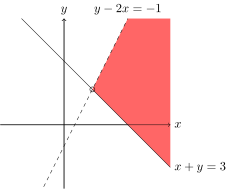
Which part of the plane describes the solution of the following system of
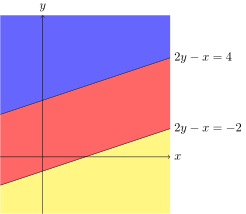
inequalities?
\[\begin{aligned}
2y - x\geq &4 & &
\\2y - x\geq & - 2 & &
\end{aligned}\]
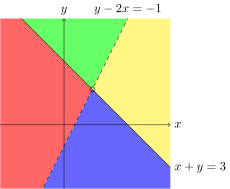
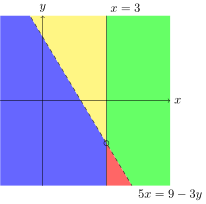
Which part of the plane describes the solution of the following system of
inequalities?
\[\begin{aligned}
x\leq &3 & &
\\5x > &9 - 3y & &
\end{aligned}\]
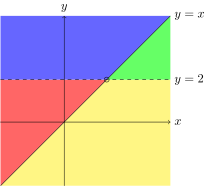
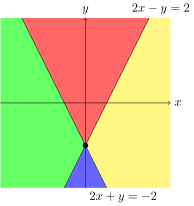
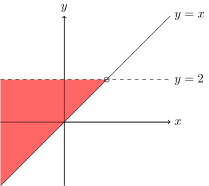
In the picture, the shaded region corresponds to the set of points that is the solution to one of the given systems of inequalities. Which of the systems is it?
A falling body dropped at a velocity
\(60\, \mathrm{m}\mathrm{s}^{-1}\). Find the
initial height \(h\),
if the relation between the velocity and the initial height
\(h\) is
\(v = \sqrt{2hg}\). Use
\(g = 10\, \mathrm{m}\mathrm{s}^{-2}\) for
acceleration of gravity.
The initial height is between \(150\, \mathrm{m}\)
and \(200\, \mathrm{m}\).
The initial height is smaller than \(100\, \mathrm{m}\).
The initial height is between \(100\, \mathrm{m}\)
and \(150\, \mathrm{m}\).
The initial height is bigger than \(200\, \mathrm{m}\).