C

9000106901

Level: 
C
A body is thrown at the initial angle \(\alpha = 45^{\circ }\) and the initial velocity \(v_{0} = 10\, \mathrm{m}/\mathrm{s}\). The trajectory of the body is a parabola. Find the equation of this parabola. Hint: The coordinates of the moving body as functions of time are \[ \begin{aligned}x& = v_{0}t\cdot \cos \alpha , & \\y& = v_{0}t\cdot \sin \alpha -\frac{1} {2}gt^{2}. \\ \end{aligned} \] Consider the standard acceleration due to gravity \(g = 10\, \mathrm{m}/\mathrm{s}^{2}\).
\((x - 5)^{2} = -10\cdot (y - 2.5)\)
\((x - 5)^{2} = 10\cdot (y + 2.5)\)
\(x^{2} = -10\cdot (y - 5)\)
\((x - 5)^{2} = -10\cdot (y + 2.5)\)

9000106902

Level: 
C
Consider a planet traveling around the Sun on an elliptic trajectory. In the perihelion (the point where the planet is nearest to the Sun) is the distance from the planet to the Sun \(4.5\, \mathrm{AU}\). The excentricity of the ellipse is \(0.5\, \mathrm{AU}\). Find the equation for the trajectory of the planet. Use the coordinate system with center in the Sun and \(x\)-axis along the major axis of the ellipse.
\(\frac{(x-0.5)^{2}} {25} + \frac{y^{2}} {24.75} = 1\)
\(\frac{x^{2}} {25} + \frac{(y-0.5)^{2}} {24.75} = 1\)
\(\frac{x^{2}} {25} + \frac{y^{2}} {24.75} = 1\)
\(\frac{(x-0.5)^{2}} {24.75} + \frac{y^{2}} {25} = 1\)

9000106904

Level: 
C
The motion with a constant deceleration is described by the relation \[ s = v_{0}t -\frac{1} {2}at^{2}. \] Consequently, the graph which shows the distance as a function of time is part of a parabola. Find the focus of this parabola, if \(v_{0} = 16\, \mathrm{m}/\mathrm{s}\) and \(a = 4\, \mathrm{m}/\mathrm{s}^{2}\).
\([4;\ 31.875]\)
\([8;\ 31.875]\)
\([4;\ 63.5]\)
\([8;\ 63.5]\)

9000106307

Level: 
C
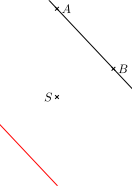
Given points \(A = [0;0;1]\), \(B = [2;0;-1]\) and \(S = [2;1;0]\), find the parametric equations of the image of the line \(AB\) in a point reflection about the point \(S\).
\(\begin{aligned}[t] x& =\phantom{ -}4 + t, & \\y& =\phantom{ -}2, \\z& = -1 - t;\ t\in \mathbb{R} \\ \end{aligned}\)
\(\begin{aligned}[t] x& = 2 + 2m, & \\y& = 2 +\phantom{ 2}m, \\z& = 1 -\phantom{ 2}m;\ m\in \mathbb{R} \\ \end{aligned}\)
\(\begin{aligned}[t] x& =\phantom{ -}4 + 2k, & \\y& =\phantom{ -}2 +\phantom{ 2}k, \\z& = -1 -\phantom{ 2}k;\ k\in \mathbb{R} \\ \end{aligned}\)
\(\begin{aligned}[t] x& = -2 + 2u, & \\y& =\phantom{ -}2, \\z& =\phantom{ -}1 - 2u;\ u\in \mathbb{R} \\ \end{aligned}\)

9000104503

Level: 
C
Solve the following equation with unknown \(x\) and a real parameter \(a\in\mathbb{R}\). \[\frac{a^{2}(x-1)} {ax-2} = 2\]
\(\begin{array}{cc} \hline \text{Parameter} & \text{Solution set}\\ \hline a=0 & \emptyset \\ a=2 & \mathbb{R}\setminus\{1\} \\ a\notin\{0;2\} & \left\lbrace\frac{a+2}a\right\rbrace \\\hline \end{array}\)
\(\begin{array}{cc} \hline \text{Parameter} & \text{Solution set}\\ \hline a\in\{0;2\} & \mathbb{R} \\ a\notin\{0,2\} & \left\{\frac{a+2}a\right\} \\\hline \end{array}\)
\(\begin{array}{cc} \hline \text{Parameter} & \text{Solution set}\\ \hline a=0 & \emptyset \\ a=2 & \mathbb{R} \\ a\notin\{0;2\} & \left\lbrace\frac{a+2}a\right\rbrace \\\hline \end{array}\)
\(\begin{array}{cc} \hline \text{Parameter} & \text{Solution set}\\ \hline a=0 & \mathbb{R}\setminus\{1\} \\ a=2 & \emptyset \\ a\notin\{0;2\} & \left\lbrace\frac{a+2}a\right\rbrace \\\hline \end{array}\)

9000104504

Level: 
C
Solve the following equation with unknown \(x\) and a real parameter \(a\in\mathbb{R}\setminus\{0\}\). \[\frac{1} {x-a} + 1 = \frac{1} {a}\]
\(\begin{array}{cc} \hline \text{Parameter} & \text{Solution set}\\ \hline a=1 & \emptyset \\ a\notin\{0,1\} & \left\lbrace\frac{a(a-2)}{a-1}\right\rbrace \\\hline \end{array}\)
\(\begin{array}{cc} \hline \text{Parameter} & \text{Solution set}\\ \hline a=1 & \mathbb{R}\setminus\{1\} \\ a\notin\{0;1\} & \left\lbrace\frac{a(a-2)}{a-1}\right\rbrace \\\hline \end{array}\)
\(\begin{array}{cc} \hline \text{Parameter} & \text{Solution set}\\ \hline a=1 & \mathbb{R} \\ a\notin\{0,1\} & \left\lbrace\frac{a(a-2)}{a-1}\right\rbrace \\\hline \end{array}\)

9000104801

Level: 
C
Consider the hyperbola \[ xy = -1 \] and a line \(p\) parallel to one of the axes but not identical with this axis. Find the true statement.
The line \(p\) has a unique intersection with the hyperbola.
The line \(p\) has two intersections with the hyperbola.
The line \(p\) does not have any intersection with the hyperbola.
We cannot draw any conclusion on the number of intersections of the line \(p\) with the hyperbola.

9000104803

Level: 
C
Consider the hyperbola \[ \frac{x^{2}} {16} -\frac{y^{2}} {4} = 1 \] and a line \(p\) parallel to one of the axes. Find the true statement.
We cannot draw any conclusion on the number of intersections of the line \(p\) with the hyperbola.
The line \(p\) has two intersections with the hyperbola.
The line \(p\) has a unique intersection with the hyperbola.
The line \(p\) does not have any intersection with the hyperbola.

9000104805

Level: 
C
Find the slope of a line through the center of the hyperbola \[ \frac{(x - 2)^{2}} {4} -\frac{(y + 3)^{2}} {9} = 1 \] which has a unique intersection with this hyperbola.
There is no solution, the line with these properties does not exist.
\(\frac{3} {2}\)
\(-\frac{3} {2}\)
\(\frac{2} {3}\)
\(1\)
\(0\)