C

9000145403

Level: 
C
Identify a true statement on the function \(f(x)= \frac{4-3x} {x\left (1-x\right )}\).
The function \(f\) has a local minimum at the point \(x = \frac{2} {3}\).
The function \(f\) has a local maximum at the point \(x = \frac{2} {3}\).
The global maximum of \(f\) on \(\mathbb{R}\setminus \{0.1\}\) is at \(x = \frac{2} {3}\).
The global minimum of \(f\) on \(\mathbb{R}\setminus \{0.1\}\) is at \(x = \frac{2} {3}\).

9000140001

Level: 
C
Consider the equation \[ \frac{4a} {x} - \frac{1} {ax} + \frac{2} {a} = 4 \] with unknown \(x\) and a parameter \(a\in \mathbb{R}\setminus \{0\}\). Identify a true statement.
If \(a = \frac{1} {2}\), then the solution is \(x\in \mathbb{R}\setminus \{0\}\).
If \(a = \frac{1} {2}\), then the equation has no solution.
If \(a = \frac{1} {2}\), then the solution is \(x\in \mathbb{R}\).

9000140004

Level: 
C
Solve the following equation with unknown \(x\) and a real parameter \(a\in\mathbb{R}\). \[ \frac{a^{2}(x-1)} {ax-3} = 3 \]
\(\begin{array}{cc} \hline \text{Parameter} & \text{Solution set}\\ \hline a=0 & \emptyset \\ a=3 & \mathbb{R}\setminus\{1\} \\ a\notin\{0;3\} & \left\{\frac{a+3}a\right\} \\ \hline \end{array}\)
\(\begin{array}{cc} \hline \text{Parameter} & \text{Solution set}\\ \hline a=0 & \emptyset \\ a=3 & \{1\} \\ a\notin\{0;3\} & \left\{\frac{a+3}a\right\} \\ \hline \end{array}\)
\(\begin{array}{cc} \hline \text{Parameter} & \text{Solution set}\\ \hline a\in\{0;3\} & \emptyset \\ a\notin\{0;3\} & \left\{\frac{a+3}a\right\} \\ \hline \end{array}\)
\(\begin{array}{cc} \hline \text{Parameter} & \text{Solution set}\\ \hline a=0 & \emptyset \\ a=3 & \mathbb{R} \\ a\notin\{0;3\} & \left\{\frac{a+3}a\right\} \\ \hline \end{array}\)

9000140005

Level: 
C
Solve the following equation with unknown \(x\) and a real parameter \(a\in\mathbb{R}\setminus\{0\}\). \[\frac ax-\frac4{ax}=1-\frac2a\]
\(\begin{array}{cc} \hline \text{Parameter} & \text{Solution set}\\ \hline a=-2 & \emptyset \\ a=2 & \mathbb{R}\setminus\{0\} \\ a\notin\{-2;0;2\} & \left\{a+2\right\} \\ \hline \end{array}\)
\(\begin{array}{cc} \hline \text{Parameter} & \text{Solution set}\\ \hline a=2 & \mathbb{R}\setminus\{0\} \\ a\notin\{0;2\} & \left\{a+2\right\} \\ \hline \end{array}\)
\( \begin{array}{cc} \hline \text{Parameter} & \text{Solution set}\\ \hline a=2 & \mathbb{R} \\ a\notin\{0;2\} & \left\{a+2\right\} \\ \hline \end{array}\)
\(\begin{array}{cc} \hline \text{Parameter} & \text{Solution set}\\ \hline a=2 & \mathbb{R}\setminus\{1\} \\ a\notin\{0;2\} & \left\{a+2\right\} \\ \hline \end{array}\)

9000139710

Level: 
C
The wallet contains nine coins: three \(1\)-Euro coins, three \(2\)-Euro coins and three \(5\)-Euro coins. How many different amounts can be paid if we have to pay the amount exactly and use just three coins for this payment?
\(\frac{5!} {3!\, 2!}=10\)
\(\frac{5!} {3!}=20\)
\(3^{3}=27\)
\(3!=6\)

9000139704

Level: 
C
There are \(5\) different kinds of cakes in a shop. Find the number of possibilities how to buy \(8\) cakes in this shop. (There is more than \(8\) cakes of each kind available.)
\(\frac{12!} {8!\, 4!}=495\)
\(5!\, 8!=4\:838\:400\)
\(5^{8}=390\:625\)
\(\frac{8!} {5!\, 3!}=56\)

9000138305

Level: 
C
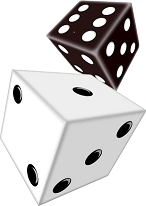
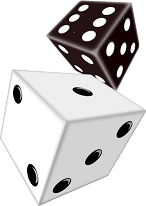
Two different dices (a white dice and a black dice) are rolled. We get the sum of the numbers on both dices \(6\). Find the probability that there is an even number on the black dice.
\(\frac{2} {5}=0{.}4\)
\(\frac{5} {36}\doteq 0{.}1389\)
\(\frac{5} {18}\doteq 0{.}2778\)
\(\frac{13} {36}\doteq 0{.}3611\)

9000138308

Level: 
C
Two different dices (a white dice and a black dice) are rolled. The sum of the numbers on both dices is \(8\). Find the probability that there is \(4\) on the black dice.
\(\frac{1} {5}=0{.}2\)
\(\frac{1} {4}=0{.}25\)
\(\frac{6} {36}\doteq 0{.}1667\)
\(\frac{11} {36}\doteq 0{.}3056\)

9000124501

Level: 
C
Similar triangles can be used to estimate the distance from a distant object of a given width. Consider a door of the width \(85\, \mathrm{cm}\). A man stands in an unknown distance from the door and holds a thin pencil vertically in his arm in the distance \(35\, \mathrm{cm}\) from his face. If he closes the left eye, the right eye, the pencil and the left side of the door are aligned in one line. In a similar way, his left eye, the pencil and the right hand side of the door are also aligned in one line, which is apparent when closing the right eye. Assuming the distance \(6\, \mathrm{cm}\) between his eyes, estimate the distance from the man to the door. Give your answer in meters and round to one decimal place.
\(5.3\, \mathrm{m}\)
\(5.0\, \mathrm{m}\)
\(0.5\, \mathrm{m}\)
\(4.5\, \mathrm{m}\)