Quadratic functions

9000014808

Level: 
A
Find the intervals of monotonicity of the quadratic function \(f(x) = 2x^{2} + 3\).
The function is increasing on \(\left [ 0;\infty \right )\) and decreasing on \(\left (-\infty ;0\right ] \).
The function is increasing on \(\left (3;\infty \right )\) and decreasing on \(\left (-\infty ;3\right )\).
The function is increasing on \(\left [ -\frac{3} {2};\infty \right )\) and decreasing on \(\left (-\infty ;-\frac{3} {2}\right ] \).
The function is increasing on its domain.

9000007102

Level: 
C
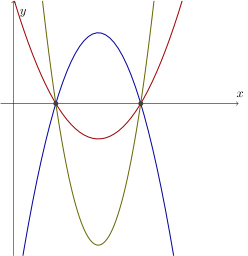
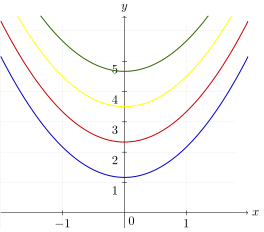
Consider a family \(M\) of quadratic functions, as shown in the picture. Any quadratic function in this family is given by the analytic expression \[ y = ax^{2} + bx + c \] where \(a\), \(b\) and \(c\) are real constants and \(a\not = 0\). For each function the set \(K\) denotes the set of \(x\)-intercepts. Complete the statement. „The analytic expressions for functions in the family \(M\) differ only in ....”
the coefficient \(c\)
the coefficient \(a\)
the coefficient \(b\)
the solution set \(K\)

9000007101

Level: 
C
Consider a family \(M\) of quadratic functions, as shown in the picture. Any quadratic function in this family is given by the analytic expression \[ y = ax^{2} + bx + c \] where \(a\), \(b\) and \(c\) are real constants and \(a\not = 0\). For each function the set \(K\) denotes the set of \(x\)-intercepts. Complete the statement. „The analytic expressions for functions in the family \(M\) differ only in ....”
the coefficient \(a\)
the coefficient \(b\)
the coefficient \(c\)
the set \(K\)