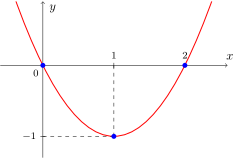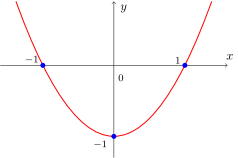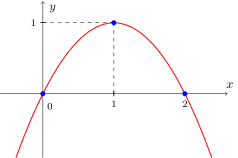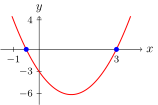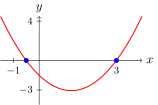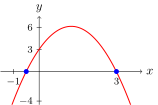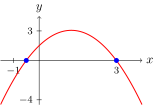
The picture shows a graph of a quadratic function and three points on the graph. In
the following list identify another point on the graph of the same quadratic
function.
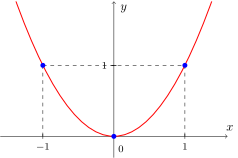
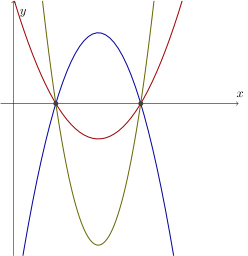
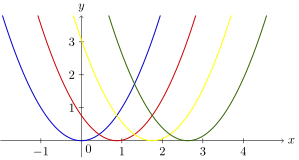
Consider a family \(M\)
of quadratic functions, as shown in the picture. Any quadratic function in this family
is given by the analytic expression
\[
y = ax^{2} + bx + c
\]
where \(a\),
\(b\) and
\(c\) are real constants and
\(a\not = 0\). For each function
the set \(K\) denotes the
set of \(x\)-intercepts. Complete the statement. „The analytic expressions for functions in the family
\(M\) share
only ....”
Consider a family \(M\)
of quadratic functions, as shown in the picture. Any quadratic function in this family
is given by the analytic expression
\[
y = ax^{2} + bx + c
\]
where \(a\),
\(b\) and
\(c\) are real constants and
\(a\not = 0\). For each function
the set \(K\) denotes the
set of \(x\)-intercepts. Complete the statement. „The analytic expressions for functions in the family
\(M\) share
only ....”
Consider a family \(M\)
of quadratic functions, as shown in the picture. Any quadratic function in this family
is given by the analytic expression
\[
y = ax^{2} + bx + c
\]
where \(a\),
\(b\) and
\(c\) are real constants and
\(a\not = 0\). For each function
the set \(K\) denotes the
set of \(x\)-intercepts. Complete the statement. „The analytic expressions for functions in the family
\(M\) share
only ....”
Consider a family \(M\)
of quadratic functions, as shown in the picture. Any quadratic function in this family
is given by the analytic expression
\[
y = ax^{2} + bx + c
\]
where \(a\),
\(b\) and
\(c\) are real constants and
\(a\not = 0\). For each function
the set \(K\) denotes the
set of \(x\)-intercepts. Complete the statement. „The analytic expressions for functions in the family
\(M\) differ
only in ....”
Consider a family \(M\)
of quadratic functions, as shown in the picture. Any quadratic function in this family
is given by the analytic expression
\[
y = ax^{2} + bx + c
\]
where \(a\),
\(b\) and
\(c\) are real constants and
\(a\not = 0\). For each function
the set \(K\) denotes the
set of \(x\)-intercepts. Complete the statement. „The analytic expressions for functions in the family
\(M\) differ
only in ....”
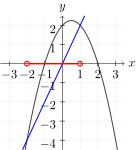
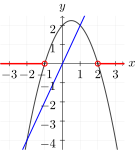
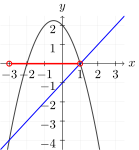
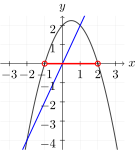
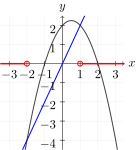
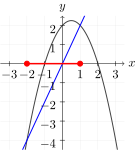
Identify a picture which shows graphical solution of the following quadratic
inequality, assuming that the solution is the red set.
\[
-x^{2} + x + 2 > 2x
\]