Polygons

1103055001

Level: 
C
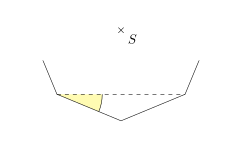
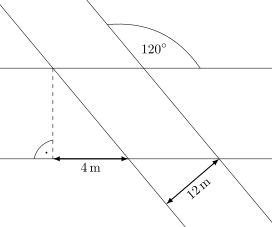
The picture shows an intersection of two streets. Two water carts passed the intersection while sprinkling entire surface of the street. Each of the carts continued along the street it came. Determine how many square meters of the streets surface were sprinkled twice?
\( 96\,\mathrm{m}^2 \)
\( 48\,\mathrm{m}^2 \)
\( 124\,\mathrm{m}^2 \)
\( 140\,\mathrm{m}^2 \)
1103055010

Level: 
C
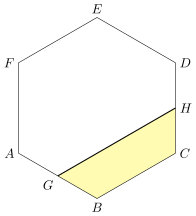
In the regular hexagon \( ABCDEF \), \( G \) and \( H \) are the midpoints of \( AB \) and \( CD \). What part of the area of the hexagon is covered by the area of the quadrilateral \( BCHG \)? The area of the quadrilateral corresponds to the shaded region in the figure.
\( \frac5{24} \)
\( \frac15 \)
\( \frac1{28} \)
\( \frac5{36} \)

1103077103

Level: 
C
The length of the shortest diagonal in a regular polygon is \( 8\,\mathrm{cm} \). The measure of the angle between this diagonal and the side of the polygon is \( 20^{\circ} \). Calculate the radius of a circle circumscribed about this polygon. Round the result to two decimal places.
\( 6.22\,\mathrm{cm} \)
\( 5.22\,\mathrm{cm} \)
\( 4.26\,\mathrm{cm} \)
\( 11.69\,\mathrm{cm} \)

2000003203

Level: 
C
A deltoid is composed of two isosceles triangles that have a common base. See the picture. Find the measures of the deltoids interior angles.
\( \alpha=36^{\circ};~\beta=134^{\circ};~\gamma=56^{\circ};~\delta=134^{\circ}\)
\( \alpha=36^{\circ};~\beta=100^{\circ};~\gamma=56^{\circ};~\delta=100^{\circ}\)
\( \alpha=56^{\circ};~\beta=134^{\circ};~\gamma=56^{\circ};~\delta=134^{\circ}\)
\( \alpha=36^{\circ};~\beta=128^{\circ};~\gamma=56^{\circ};~\delta=128^{\circ}\)

2000005504

Level: 
C
Let \(ABCD\) be an arbitrary convex quadrilateral and let’s denote by \(P\), \(Q\), \(R\), \(S\) the centers of the sides \(AB\), \(BC\), \(CD\), \(DA\) in that order. Then, what type of a quadrilateral is \(PQRS\)?
It may or may not be a parallelogram.
It is a rectangle.
It is a rectangle or a square.
It is not a parallelogram.

2000005508

Level: 
C
A rectangle with sides \(3\,\mathrm{cm}\) and \(4\,\mathrm{cm}\) long is divided by one of its diagonals into two triangles. What is the distance of the centers of gravity of these two triangles?
\(\frac{5}{3}\,\mathrm{cm}\)
\(\frac{4}{3}\,\mathrm{cm}\)
\(\frac{10}{3}\,\mathrm{cm}\)
\(2\,\mathrm{cm}\)

2000005904

Level: 
C
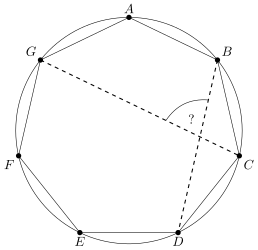
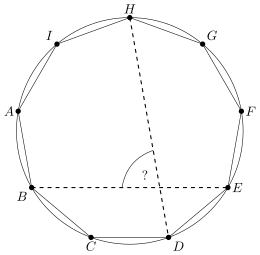
Find the magnitude of the angle that the diagonals \(DB\) and \(CG\) make in the regular heptagon \(ABCDEFG\). (See the picture.)
\( 180^{\circ}-\left(\frac{360^{\circ}}{14} +3\cdot\frac{360^{\circ}}{14}\right)\)
\( 180^{\circ}-\left(\frac{360^{\circ}}{7} +3\cdot\frac{360^{\circ}}{7}\right)\)
\( 180^{\circ}-\frac{360^{\circ}}{14} +3\cdot\frac{360^{\circ}}{14}\)
\( 180^{\circ}-\left(\frac{360^{\circ}}{14} +4\cdot\frac{360^{\circ}}{14}\right)\)