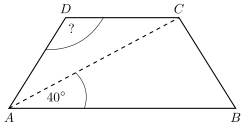
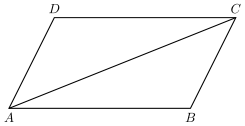
In the isosceles trapezium \( ABCD \), \( |AD|=|BC| \), \( |AB|=|AC| \) and the measure of the angle \( BAC \) is \( 40^{\circ} \). What is the measure of the angle \( ADC \)?
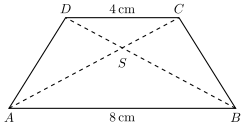
\( ABCD \) is a trapezium with bases \( |AB| = 8\,\mathrm{cm} \) and \( |CD| = 4\,\mathrm{cm} \). Calculate the area of the triangle \( ABS \) if the area of the triangle \( CDS \) is \( 12\,\mathrm{cm}^2 \), where \( S \) is the intersection point of the diagonals \( BD \) and \( AC \).
The lengths of sides of the parallelogram \( ABCD \) are \( 8\,\mathrm{cm} \) and \( 6\,\mathrm{cm} \). The size of one of its interior angles is \( 60^{\circ} \). Calculate the area of the parallelogram.
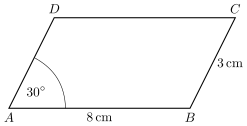
Let \( ABCD \) be a parallelogram with \( |AB| = 8\,\mathrm{cm} \), \( |BC| = 3\,\mathrm{cm} \) and the measure of \( \measuredangle DAB \) is \( 30^{\circ} \). Give the area of the parallelogram.
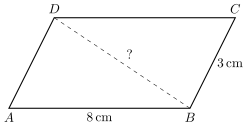
The area of the parallelogram \( ABCD \) is \( 12\,\mathrm{cm}^2 \), the lengths of its sides are \( 8\,\mathrm{cm} \) and
\( 3\,\mathrm{cm} \), as shown in the diagram. Calculate the length of the shorter diagonal. Round the result to one decimal place.
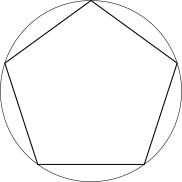
A regular pentagon is inscribed in a circle of radius \( 10\,\mathrm{cm} \). Calculate the perimeter of the pentagon. Round the result to two decimal places.
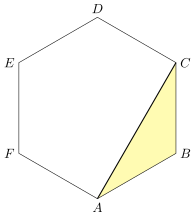
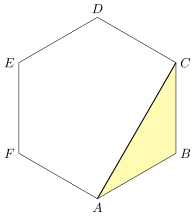
The regular hexagon \( ABCDEF \) is in the picture. The area of the triangle \( ABC \) is \( 10\,\mathrm{cm}^2 \). Calculate the length of the side of the hexagon. Round to one decimal place.