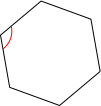
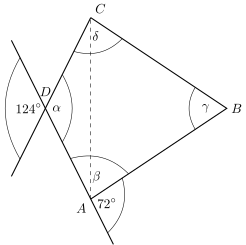
The measure of the interior angle in a regular polygon is \(160^{\circ}\). Find the number of vertices of this polygon. In the figure the interior angle (marked in red) of a regular hexagon is shown.
The number of diagonals in a regular polygon is
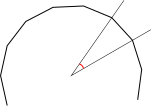
\(2.5\)-times bigger than the number of the sides of this polygon. In the figure the cut of a regular polygon with unspecified number of vertices is shown. The red angle is the central angle of the polygon. Find the central angle of the
polygon.
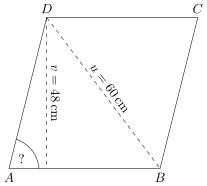
\( ABCD \) is a rhombus, the height \( v = 48\,\mathrm{cm} \) and the shorter diagonal \( u = 60\,\mathrm{cm} \). Determine the measure of the acute interior angle of the rhombus. Round the result to two decimal places.
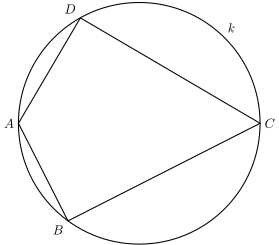
Consider a circle \( k \) with radius \( 2.5\,\mathrm{cm} \). In the circle is inscribed a convex quadrilateral \( ABCD \) so that the diagonal \( AC \) is the diameter of the circle, the length of \( BC \) is \( \sqrt{21}\,\mathrm{cm} \), and the length of \( DC \) is \( 4\,\mathrm{cm} \). What is the length of the shortest side of this quadrilateral? (See the picture.)
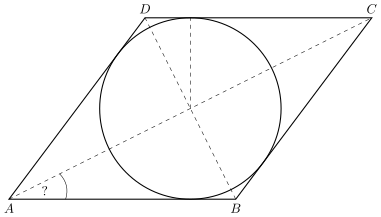
A circle is inscribed in a rhombus \( ABCD \). The touching points of the circle and the rhombus divide each side into two parts that are \( 12\,\mathrm{dm} \) and \( 25\,\mathrm{dm} \) long. (See the picture.) Find the measure of the angle \( CAB \). Round the result to two decimal places.
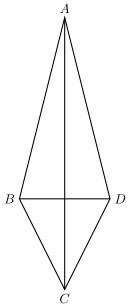
In the convex quadrilateral \( ABCD \), \( |AB| = |DA| = 20\,\mathrm{cm} \), \( |BC| = |CD| = 15\,\mathrm{cm} \). The diagonal \( AC \) is \( 25\,\mathrm{cm} \) long. Give the measure of the angle \( ABC \).
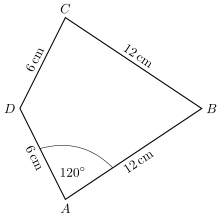
In the kite \( ABCD \), \( |AB| = |BC| = 12\,\mathrm{cm} \), \( |CD| = |DA| = 6\,\mathrm{cm} \), and the measure of \( \measuredangle DAB \) is \( 120^{\circ} \). Calculate the area of the kite.