Puntos y vectores

1103020801

Parte: 
A
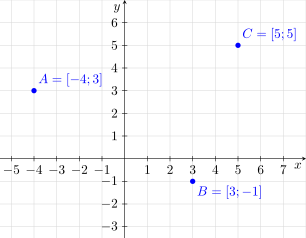
Determina las coordenadas de los puntos medios de los segmentos \( AB \), \( BC \), \( AC \). Para encontrar las coordenadas de los puntos \( A \), \( B \) y \( C \), mira la imagen.
\( S_{AB}=\left[-\frac12;1 \right]\text{, }\ S_{BC}=[4;2 ]\text{, }\ S_{AC}=\left[\frac12; 4\right] \)
\( S_{AB}=\left[-\frac32;2 \right]\text{, }\ S_{BC}=[1;3 ]\text{, }\ S_{AC}=\left[\frac52; 4\right] \)
\( S_{AB}=\left[\frac12;1 \right]\text{, }\ S_{BC}=[4;2 ]\text{, }\ S_{AC}=\left[-\frac12; 4\right] \)
\( S_{AB}=\left[1;-\frac12 \right]\text{, }\ S_{BC}=[2;4 ]\text{, }\ S_{AC}=\left[4;\frac12\right] \)

1103020808

Parte: 
A
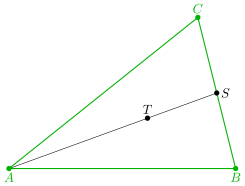
Sea \( ABC \) un triángulo. En la imagen se puede ver el centro del lado \( BC \) y el bicentro de este triángulo. De las siguientes relaciones vectoriales, selecciona la que no sea verdadera.
\( \overrightarrow{ST}= \frac12 \overrightarrow{AT} \)
\( \overrightarrow{AT}= \frac23\overrightarrow{AS} \)
\( \overrightarrow{ST} = -\frac13\overrightarrow{AS} \)
\( \overrightarrow{SA}= -3\overrightarrow{TS} \)

1003030605

Parte: 
B
Sean \( \overrightarrow{a}=(3;-5) \) y \( \overrightarrow{b}=(6;-10) \). Determina todos los vectores \( \overrightarrow{c} \) par los que se cumple que : \[ \overrightarrow{a}\cdot\overrightarrow{c}=11\ \text{ y }\ \overrightarrow{b}\cdot\overrightarrow{c}=22\text{ .} \]
\( \overrightarrow{c}=(2+5k;-1+3k);\ k\in\mathbb{R} \)
\( \overrightarrow{c}_1=(7;2);\ \overrightarrow{c}_2=(-7;-2) \)
\( \overrightarrow{c}=(2k;-k);\ k\in\mathbb{R} \)
\( \overrightarrow{c}_1=(2;-1);\ \overrightarrow{c}_2=(-2;1) \)

1003030604

Parte: 
B
Sean \( \overrightarrow{a}=(2;- 3) \) y \( \overrightarrow{b}=(3;-2) \). Determina todos los vectores \( \overrightarrow{c} \) para los que se cumple : \[ \overrightarrow{a}\cdot\overrightarrow{c}=8\ \text{ y }\ \overrightarrow{b}\cdot\overrightarrow{c}=27. \]
\( \overrightarrow{c}=(13;6) \)
\( \overrightarrow{c_1}=(13;6);\ \overrightarrow{c_2}=(-13;-6) \)
\( \overrightarrow{c}=(13k;6k);\ k\in\mathbb{R} \)
\( \overrightarrow{c}=(-13;-6) \)

1003030603

Parte: 
B
Sea\( \overrightarrow{v}=(12;5) \). Determina todos los vectores \( \overrightarrow{u} \) que son perpendiculares al vector \( \overrightarrow{v} \) y cuya longitud es \( 26 \).
\( \overrightarrow{u_1} =(10;-24);\ \overrightarrow{u_2}=(-10; 24) \)
\( \overrightarrow{u}=(10;-24) \)
\( \overrightarrow{u_1}=\frac12 (5;-12);\ \overrightarrow{u_2}=\frac12 (-5; 12) \)
\( \overrightarrow{u_1}=26\cdot(5;-12);\ \overrightarrow{u_2}=26\cdot(-5; 12) \)

1103030601

Parte: 
B
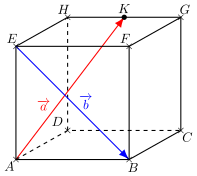
En el cubo \( ABCDEFGH \) determina el ángulo \( \varphi \) entre los vectores \( \overrightarrow{b}=\overrightarrow{EB} \) y \( \overrightarrow{a}=\overrightarrow{AK} \), donde \( K \) es el centro de \( HG \). Redondea \( \varphi \) al grado más cercano. Pista: Elige un sistema de coordenadas apropiado.
\( \varphi\doteq 104^{\circ} \)
\( \varphi\doteq 76^{\circ} \)
\( \varphi\doteq 100^{\circ} \)
\( \varphi\doteq 80^{\circ} \)

1103024310

Parte: 
A
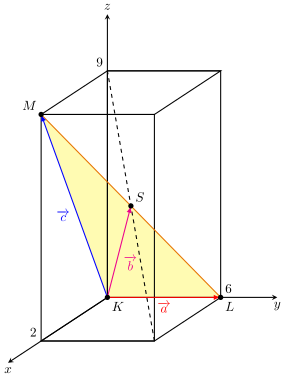
La imagen muestra el triángulo \( KLM \) con los vectores indicados \( \overrightarrow{a} \), \( \overrightarrow{b} \), \( \overrightarrow{c} \) en un sistema de coordenadas. ¿Cuáles son las coordenadas del vector\( \overrightarrow{b} \)? Expresa \( \overrightarrow{b} \) como combinación lineal de los vectores \( \overrightarrow{a} \) y \( \overrightarrow{c} \).
\( \overrightarrow{b} = \left(1;3;4.5\right);\ \overrightarrow{b} = \frac12\overrightarrow{a} + \frac12\overrightarrow{c} \)
\( \overrightarrow{b} = \left(3;1;4.5\right);\ \overrightarrow{b} = \overrightarrow{a} + \overrightarrow{c} \)
\( \overrightarrow{b} = \left(1;3;4.5\right);\ \overrightarrow{b} = \overrightarrow{a} + \overrightarrow{c} \)
\( \overrightarrow{b} = \left(3;1;4.5\right);\ \overrightarrow{b} = \frac12\overrightarrow{a} + \frac12\overrightarrow{c} \)

1103024309

Parte: 
A
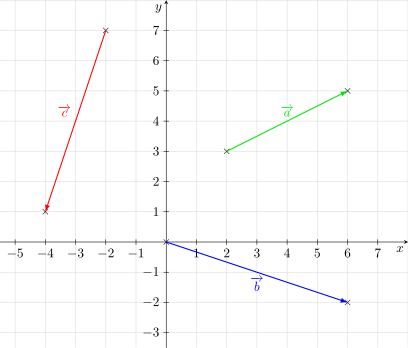
Dados los vectores \( \overrightarrow{a} \), \( \overrightarrow{b} \), \( \overrightarrow{c} \) mostrados en la imagen, expresa el vector \( \overrightarrow{b} \) como combinación lineal de los vectores \( \overrightarrow{a} \) y \( \overrightarrow{c} \).
\( \overrightarrow{b} = 2\overrightarrow{a} + \overrightarrow{c} \)
\( \overrightarrow{b} = 2\overrightarrow{a} - \overrightarrow{c} \)
\( \overrightarrow{b} = -2\overrightarrow{a} + \overrightarrow{c} \)
\( \overrightarrow{b} = -2\overrightarrow{a} - \overrightarrow{c} \)