C

1003107505

Level: 
C
Find the complex roots of the following quadratic equation. \[ 4\mathrm{i}x^2 + 1 = 0 \]
\( x_1=\frac{\sqrt2}4+\frac{\sqrt2}4\mathrm{i}\text{, }\ x_2=-\frac{\sqrt2}4-\frac{\sqrt2}4\mathrm{i} \)
\( x_1=-\frac{\sqrt2}4+\frac{\sqrt2}4\mathrm{i}\text{, }\ x_2=\frac{\sqrt2}4-\frac{\sqrt2}4\mathrm{i} \)
\( x_1=\frac12+\frac12\mathrm{i}\text{, }\ x_2=-\frac12-\frac12\mathrm{i} \)
\( x_1=-\frac12+\frac12\mathrm{i}\text{, }\ x_2=\frac12-\frac12\mathrm{i} \)

1003107504

Level: 
C
Find the complex roots of the following quadratic equation. \[ 16\mathrm{i}x^2- 9\mathrm{i}^3 = 0 \]
\( x_1=\frac34\mathrm{i}\text{, }\ x_2=-\frac34\mathrm{i} \)
\( x_1=\frac34\text{, }\ x_2=-\frac34\)
\( x_1=\frac43\mathrm{i}\text{, }\ x_2=-\frac43\mathrm{i} \)
\( x_1=\frac43\text{, }\ x_2=-\frac43 \)

1003107503

Level: 
C
Find the complex roots of the following quadratic equation. \[ (3-\mathrm{i})x^2-(1-2\mathrm{i})x = 0 \]
\( x_1=0\text{, }\ x_2=\frac12-\frac12\mathrm{i} \)
\( x_1=0\text{, }\ x_2=-\frac12+\frac12\mathrm{i} \)
\( x_1=0\text{, }\ x_2=\frac12+\frac12\mathrm{i} \)
\( x_1=0\text{, }\ x_2=-\frac12-\frac12\mathrm{i} \)

1003107501

Level: 
C
Find the complex roots of the following quadratic equation. \[ 2\mathrm{i}\,x^2 - 5\mathrm{i}\,x = 0 \]
\( x_1=0\text{, }\ x_2 = \frac52 \)
\( x_1=0\text{, }\ x_2 = \frac52\mathrm{i} \)
\( x_1=0\text{, }\ x_2 = -\frac52 \)
\( x_1=0\text{, }\ x_2 = -\frac52\mathrm{i} \)

1003118406

Level: 
C
All the solutions of the equation \( x^4+1+\sqrt3\mathrm{i} = 0 \) are complex numbers, whose arguments are from the interval \( [0; 2\pi) \). Find the sum of the arguments of all the solutions of the equation.
\( \frac{13}3\pi \)
\( 4\pi \)
\( \frac{25}6\pi \)
\( \frac92\pi \)

1003118405

Level: 
C
All the solutions of the equation \( x^6-4\sqrt3+4\mathrm{i} = 0 \) can be displayed as points in the rectangular coordinate system. What is the distance of the two most distant points?
\( 2\sqrt2 \)
\( \sqrt2 \)
\( 2\sqrt[3]4 \)
\( \sqrt[3]4 \)
\( 2\sqrt3 \)
\( \sqrt3 \)

1103118404

Level: 
C
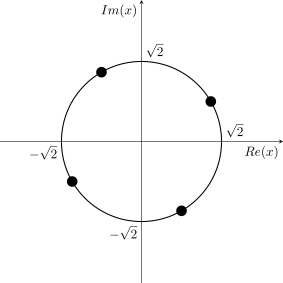
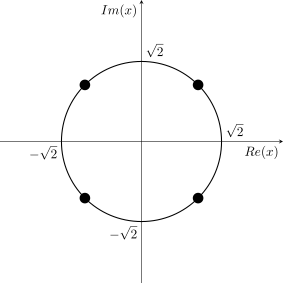
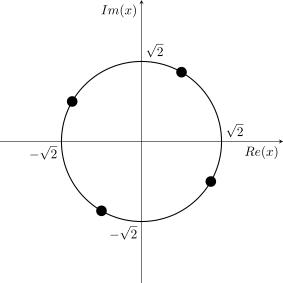
Consider an equation \( x^n+b=0 \), where \( n \) is a positive integer and \( b \) is a complex number. In the picture the points that correspond to the roots of the equation are depicted in black. Find the equation.
\( x^3 + 4\sqrt2 - 4\sqrt2\mathrm{i} = 0 \)
\( x^3 + 4\sqrt2 +4\sqrt2\mathrm{i} = 0 \)
\( x^3 - 4\sqrt2 - 4\sqrt2\mathrm{i} = 0 \)
\( x^3 - 4\sqrt2 +4\sqrt2\mathrm{i} = 0 \)

1003118402

Level: 
C
Which of the given complex numbers is not a root of the equation \( x^6 + 8\mathrm{i} = 0 \)?
\( 1-\mathrm{i} \)
\( 1+\mathrm{i} \)
\( -1-\mathrm{i} \)
\( \sqrt2\left(\cos\frac{7\pi}{12}+\mathrm{i}\cdot\sin\frac{7\pi}{12}\right) \)
\( \sqrt2\left(\cos\frac{23\pi}{12}+\mathrm{i}\cdot\sin\frac{23\pi}{12}\right) \)