2000018702
Level:
B
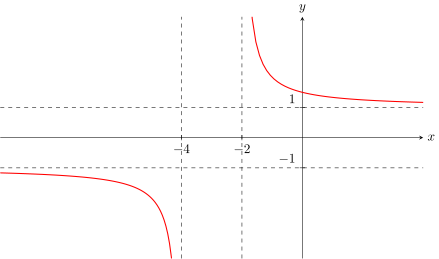
Choose the true statement about the limits of the function whose graph is shown in the picture. (Note: The dashed lines are asymptotes of the function.)
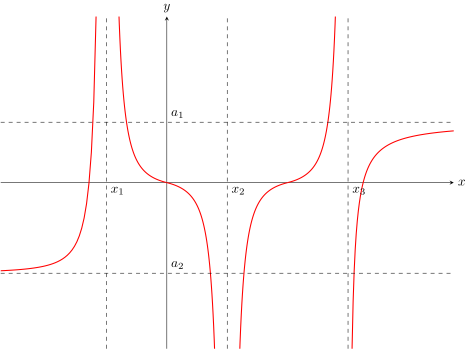
The function has the limit "negative infinity" only at \(x_2\) and at "negative infinity" it has the limit \(a_2\).
The function has the limit "negative infinity" at \(x_2\) and \(x_3\) and at "negative infinity" it has the limit \(a_2\).
The function has the limit "negative infinity" only at \(x_2\) and at "negative infinity" there is no limit.
The function has the limit "negative infinity" at \(x_2\) and \(x_3\) and at "negative infinity" there is no limit.