Punkty i wektory

1103020801

Część: 
A
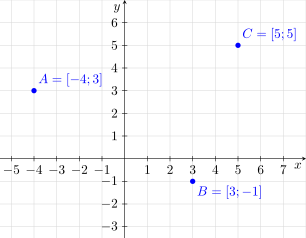
Wskaż współrzędne środka odcinków \( AB \), \( BC \), \( AC \). Współrzędne punktów \( A \), \( B \) i \( C \) wskazano na rysunku.
\( S_{AB}=\left[-\frac12;1 \right]\text{, }\ S_{BC}=[4;2 ]\text{, }\ S_{AC}=\left[\frac12; 4\right] \)
\( S_{AB}=\left[-\frac32;2 \right]\text{, }\ S_{BC}=[1;3 ]\text{, }\ S_{AC}=\left[\frac52; 4\right] \)
\( S_{AB}=\left[\frac12;1 \right]\text{, }\ S_{BC}=[4;2 ]\text{, }\ S_{AC}=\left[-\frac12; 4\right] \)
\( S_{AB}=\left[1;-\frac12 \right]\text{, }\ S_{BC}=[2;4 ]\text{, }\ S_{AC}=\left[4;\frac12\right] \)

1103020808

Część: 
A
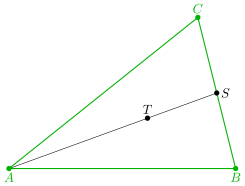
Dano trójkąt \( ABC \). Na rysunku wskazano środek boku \( BC \) i środek ciężkości trójkąta. Z poniższych zależności wybierz tą, która nie jest prawdziwa.
\( \overrightarrow{ST}= \frac12 \overrightarrow{AT} \)
\( \overrightarrow{AT}= \frac23\overrightarrow{AS} \)
\( \overrightarrow{ST} = -\frac13\overrightarrow{AS} \)
\( \overrightarrow{SA}= -3\overrightarrow{TS} \)

1003030605

Część: 
B
Dane są wektory \( \overrightarrow{a}=(3;-5) \) i \( \overrightarrow{b}=(6;-10) \). Wskaż wszystkie wektory \( \overrightarrow{c} \) tak, aby \[ \overrightarrow{a}\cdot\overrightarrow{c}=11\ \text{ i }\ \overrightarrow{b}\cdot\overrightarrow{c}=22\text{ .} \]
\( \overrightarrow{c}=(2+5k;-1+3k);\ k\in\mathbb{R} \)
\( \overrightarrow{c}_1=(7;2);\ \overrightarrow{c}_2=(-7;-2) \)
\( \overrightarrow{c}=(2k;-k);\ k\in\mathbb{R} \)
\( \overrightarrow{c}_1=(2;-1);\ \overrightarrow{c}_2=(-2;1) \)

1003030604

Część: 
B
Podano \( \overrightarrow{a}=(2;- 3) \) i \( \overrightarrow{b}=(3;-2) \). Wskaż wszystkie wektory \( \overrightarrow{c} \) tak, aby \[ \overrightarrow{a}\cdot\overrightarrow{c}=8\ \text{ i }\ \overrightarrow{b}\cdot\overrightarrow{c}=27. \]
\( \overrightarrow{c}=(13;6) \)
\( \overrightarrow{c_1}=(13;6);\ \overrightarrow{c_2}=(-13;-6) \)
\( \overrightarrow{c}=(13k;6k);\ k\in\mathbb{R} \)
\( \overrightarrow{c}=(-13;-6) \)

1003030603

Część: 
B
Dany jest wektor \( \overrightarrow{v}=(12;5) \). Wskaż wszystkie wektory \( \overrightarrow{u} \) prostopadłe do wektora \( \overrightarrow{v} \), których długość jest równa \( 26 \).
\( \overrightarrow{u_1} =(10;-24);\ \overrightarrow{u_2}=(-10; 24) \)
\( \overrightarrow{u}=(10;-24) \)
\( \overrightarrow{u_1}=\frac12 (5;-12);\ \overrightarrow{u_2}=\frac12 (-5; 12) \)
\( \overrightarrow{u_1}=26\cdot(5;-12);\ \overrightarrow{u_2}=26\cdot(-5; 12) \)

1103030601

Część: 
B
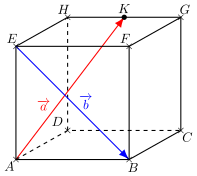
W sześcianie \( ABCDEFGH \) wyznacz kąt \( \varphi \) między wektorami \( \overrightarrow{b}=\overrightarrow{EB} \) i \( \overrightarrow{a}=\overrightarrow{AK} \), gdzie \( K \) to środek \( HG \). Zaokrągli \( \varphi \) do pełnych stopni. Wskazówka: Wybierz odpowiedni układ współrzędnych.

\( \varphi\doteq 104^{\circ} \)
\( \varphi\doteq 76^{\circ} \)
\( \varphi\doteq 100^{\circ} \)
\( \varphi\doteq 80^{\circ} \)

1103024310

Część: 
A
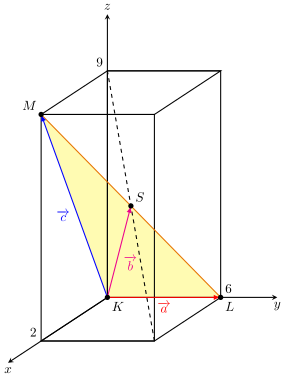
W układzie współrzędnych podano trójkąt \( KLM \) o wektorach \( \overrightarrow{a} \), \( \overrightarrow{b} \), \( \overrightarrow{c} \). Określ współrzędne wektora \( \overrightarrow{b} \). Przedstaw\( \overrightarrow{b} \) jako kombinację liniową wektorów \( \overrightarrow{a} \) i \( \overrightarrow{c} \).
\( \overrightarrow{b} = \left(1;3;4{,}5\right);\ \overrightarrow{b} = \frac12\overrightarrow{a} + \frac12\overrightarrow{c} \)
\( \overrightarrow{b} = \left(3;1;4{,}5\right);\ \overrightarrow{b} = \overrightarrow{a} + \overrightarrow{c} \)
\( \overrightarrow{b} = \left(1;3;4{,}5\right);\ \overrightarrow{b} = \overrightarrow{a} + \overrightarrow{c} \)
\( \overrightarrow{b} = \left(3;1;4{,}5\right);\ \overrightarrow{b} = \frac12\overrightarrow{a} + \frac12\overrightarrow{c} \)

1103024309

Część: 
A
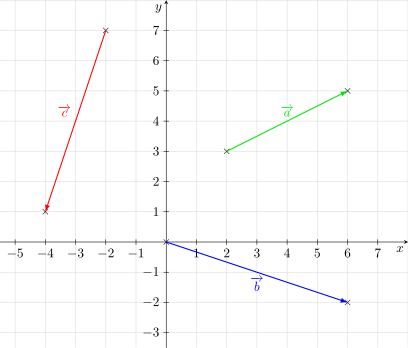
Na rysunku wskazano wektory \( \overrightarrow{a} \), \( \overrightarrow{b} \), \( \overrightarrow{c} \), przedstaw wektor \( \overrightarrow{b} \) jako kombinację liniową wektorów \( \overrightarrow{a} \) i \( \overrightarrow{c} \).
\( \overrightarrow{b} = 2\overrightarrow{a} + \overrightarrow{c} \)
\( \overrightarrow{b} = 2\overrightarrow{a} - \overrightarrow{c} \)
\( \overrightarrow{b} = -2\overrightarrow{a} + \overrightarrow{c} \)
\( \overrightarrow{b} = -2\overrightarrow{a} - \overrightarrow{c} \)