Pochodne

2010002001

Część: 
A
Oblicz pochodną funkcji. \[ f(x) = \pi -\frac{\ln 3}{x} \]
\(f'(x) = \frac{\ln 3 }{x^{2}} ;\ x\in \mathbb{R}\setminus \{0\}\)
\(f'(x) = 0 ;\ x\in \mathbb{R}\setminus \{0\}\)
\(f'(x) = \ln 3 ;\ x\in \mathbb{R}\setminus \{0\}\)
\(f'(x) = - \frac{\ln 3}{x^{2}} ;\ x\in \mathbb{R}\setminus \{0\}\)
1103164710

Część: 
A
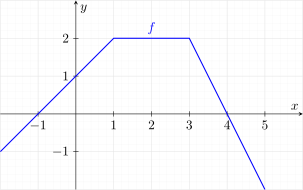
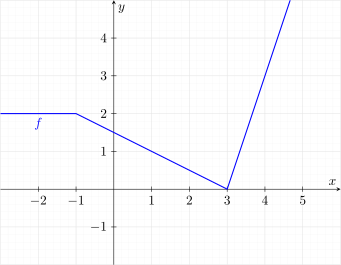
Dany jest wykres funkcji \( f \). Które z podanych wyrażeń jest poprawne? (\( f' \) jest pochodną funkcji \( f \).)
\( f'(-1)=0 \), \( f'(2)=-2 \), \( f'(4)=0 \)
\( f'(-1)=0 \), \( f'(2)=-\frac12 \), \( f'(4)=-3 \)
\( f'(-1)=0 \), \( f'(0)=0 \), \( f'(3)=0 \)
\( f'(0)=0 \), \( f'(2)=-1 \), \( f'(4)=0 \)
\( f'(0)=1 \), \( f'(2)=-2 \), \( f'(4)=-3 \)

1103164709

Część: 
A
Dany jest wykres funkcji \( f \). Które z podanych stwierdzeń jest poprawne? (\( f' \) jest pochodną funkcji \( f \).)
\( f'(-1) \) nie istnieje, \( f'(1)=-\frac12 \), \( f'(4)=3 \)
\( f'(-2)=0 \), \( f'(1)=-2 \), \( f'(3) \) nie istnieje
\( f'(-2)=0 \), \( f'(2)=-\frac32 \), \( f'(4)=3 \)
\( f'(-1)=2 \), \( f'(1)=-\frac12 \), \( f'(3) \) nie istnieje

1103164708

Część: 
A
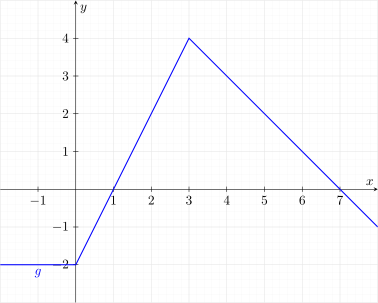
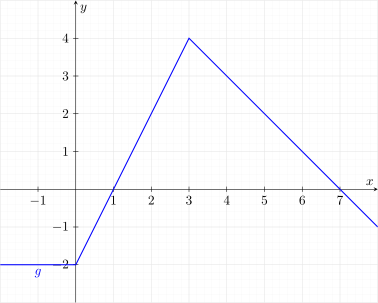
Dany jest wykres funkcji \( g \). Które z podanych stwierdzeń jest poprawne? (\( g' \) jest pochodną funkcji \( g \).)
\( g'(1)=2 \), \( g'(2)=2 \), \( g'(4)=-1 \)
\( g'(-1)=0 \), \( g'(3) \) nie istnieje, \( g'(4)=3 \)
\( g'(-1) = -2 \), \( g'(3) \) nie istnieje, \( g'(4)=-1 \)
\( g'(1)=0 \), \( g'(2)=2 \), \( g'(4)=3 \)

1103164707

Część: 
A
Dany jest wykres funkcji \( g \). Które z podanych wyrażeń jest poprawne? (\( g' \) jest pochodną funkcji \( g \).)
\( g'(-1)=0 \), \( g'(1)=2 \), \( g'(5)=-1 \)
\( g'(-1)=0 \), \( g'(1)=1 \), \( g'(5)=-1 \)
\( g'(-1)=0 \), \( g'(1)=2 \), \( g'(5)=2 \)
\( g'(-1)=-2 \), \( g'(1)=0 \), \( g'(5)=2 \)
\( g'(-1)=-2 \), \( g'(1)=2 \), \( g'(5)=2 \)

1103164706

Część: 
A
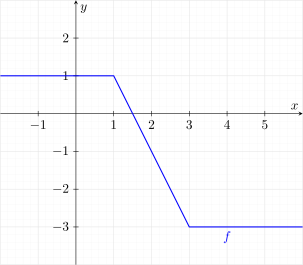
Dany jest wykres funkcji \( f \). Które z podanych stwierdzeń jest poprawne? (\( f' \) jest pochodną funkcji \( f \).)
\( f'(0)=1 \), \( f'(1) \) nie istnieje, \( f'(4)=-2 \)
\( f'(0)=1 \), \( f'(1)=0 \), \( f'(4)=-2 \)
\( f'(-1)=0 \), \( f'(2)=0 \), \( f'(3) \) nie istnieje
\( f'(-1)=1 \), \( f'(2)=0 \), \( f'(3)=0 \)