A

1103024310

Parte: 
A
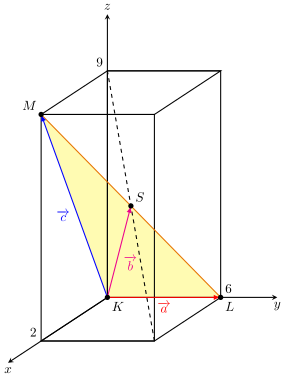
La imagen muestra el triángulo \( KLM \) con los vectores indicados \( \overrightarrow{a} \), \( \overrightarrow{b} \), \( \overrightarrow{c} \) en un sistema de coordenadas. ¿Cuáles son las coordenadas del vector\( \overrightarrow{b} \)? Expresa \( \overrightarrow{b} \) como combinación lineal de los vectores \( \overrightarrow{a} \) y \( \overrightarrow{c} \).
\( \overrightarrow{b} = \left(1;3;4.5\right);\ \overrightarrow{b} = \frac12\overrightarrow{a} + \frac12\overrightarrow{c} \)
\( \overrightarrow{b} = \left(3;1;4.5\right);\ \overrightarrow{b} = \overrightarrow{a} + \overrightarrow{c} \)
\( \overrightarrow{b} = \left(1;3;4.5\right);\ \overrightarrow{b} = \overrightarrow{a} + \overrightarrow{c} \)
\( \overrightarrow{b} = \left(3;1;4.5\right);\ \overrightarrow{b} = \frac12\overrightarrow{a} + \frac12\overrightarrow{c} \)

1103024309

Parte: 
A
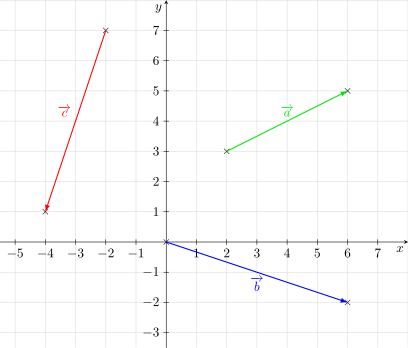
Dados los vectores \( \overrightarrow{a} \), \( \overrightarrow{b} \), \( \overrightarrow{c} \) mostrados en la imagen, expresa el vector \( \overrightarrow{b} \) como combinación lineal de los vectores \( \overrightarrow{a} \) y \( \overrightarrow{c} \).
\( \overrightarrow{b} = 2\overrightarrow{a} + \overrightarrow{c} \)
\( \overrightarrow{b} = 2\overrightarrow{a} - \overrightarrow{c} \)
\( \overrightarrow{b} = -2\overrightarrow{a} + \overrightarrow{c} \)
\( \overrightarrow{b} = -2\overrightarrow{a} - \overrightarrow{c} \)

1103024308

Parte: 
A
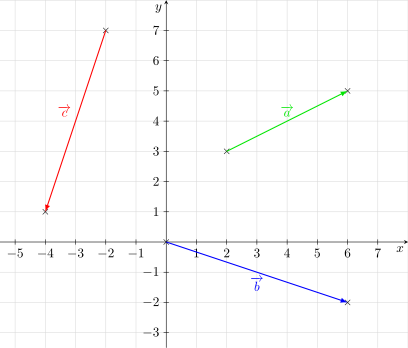
Dados los vectores \( \overrightarrow{a} \), \( \overrightarrow{b} \), \( \overrightarrow{c} \) mostrados en la imagen, expressa el vector \( \overrightarrow{c} \) como combinación lineal de los vectores \( \overrightarrow{a} \) y \( \overrightarrow{b} \).
\( \overrightarrow{c} = -2\overrightarrow{a} + \overrightarrow{b} \)
\( \overrightarrow{c} = -\overrightarrow{a} + \frac12\overrightarrow{b} \)
\( \overrightarrow{c} = -\frac32\overrightarrow{a} + \overrightarrow{b} \)
\( \overrightarrow{c} = -2\overrightarrow{a} + \frac32\overrightarrow{b} \)

1003024307

Parte: 
A
Sean \( \overrightarrow{a} = (-1;2) \), \( \overrightarrow{b} = (2;1) \), \( \overrightarrow{c} = (-4;3) \). Expresa el vector \( \overrightarrow{c} \) como combinación lineal de los vectores \( \overrightarrow{a} \) y \( \overrightarrow{b} \).
\( \overrightarrow{c} = 2\overrightarrow{a} - \overrightarrow{b} \)
\( \overrightarrow{c} = 4\overrightarrow{a} - 8\overrightarrow{b} \)
\( \overrightarrow{c} = 4\overrightarrow{a} - \overrightarrow{b} \)
\( \overrightarrow{c} = -2\overrightarrow{a} + \overrightarrow{b} \)

1003024306

Parte: 
A
Dados los puntos A = [-4;2;3], B = [-5;6;3], D = [1;1;4]. Determina las coordenadas del punto \( C \), si: \[ \overrightarrow{u} = \overrightarrow{AB}\text{, }\ \overrightarrow{CD} = -\frac12\overrightarrow{u}\]
\( C = \left[\frac12; 3; 4\right] \)
\( C = \left[-\frac12;-3;-4\right] \)
\( C = \left[\frac32;3;4\right] \)
\( C = \left[\frac32;-3;-4\right] \)

1103024305

Parte: 
A
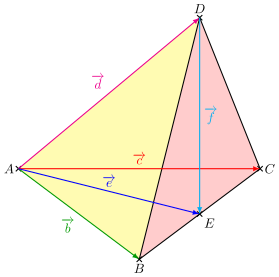
En un tetraedro \( ABCD \), sean \( \overrightarrow{b} = \overrightarrow{AB} \), \( \overrightarrow{c} = \overrightarrow{AC} \), \( \overrightarrow{d} = \overrightarrow{AD} \), \( \overrightarrow{e} = \overrightarrow{AE} \) y \( \overrightarrow{f} = \overrightarrow{DE} \). Además, sea \( E \) el punto medio de \( BC \). Expresa vectores \( \overrightarrow{e} \) y \( \overrightarrow{f} \) como combinación lineal de los vectores \( \overrightarrow{b} \), \( \overrightarrow{c} \), \( \overrightarrow{d} \).
\( \overrightarrow{e} = \frac12\overrightarrow{b} + \frac12\overrightarrow{c};\ \overrightarrow{f} = \frac12\overrightarrow{b} + \frac12\overrightarrow{c} - \overrightarrow{d} \)
\( \overrightarrow{e} = \frac12\overrightarrow{b} + \frac12\overrightarrow{d};\ \overrightarrow{f} = \overrightarrow{b} + \overrightarrow{c} + \overrightarrow{d} \)
\( \overrightarrow{e} = \overrightarrow{b} + \overrightarrow{c};\ \overrightarrow{f} =\frac12\overrightarrow{b} + \frac12\overrightarrow{c} - \overrightarrow{d} \)
\( \overrightarrow{e} = \frac12\overrightarrow{b} + \frac12\overrightarrow{c};\ \overrightarrow{f} = \frac12\overrightarrow{b} + \frac12\overrightarrow{c} + \overrightarrow{d} \)

1103024304

Parte: 
A
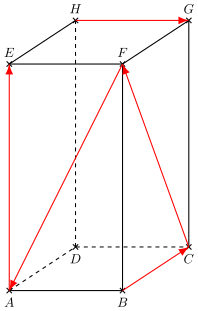
La imagen muestra un ortoedro \( ABCDEFGH \). En el ortoedro, determina el vector que es la suma de \( \overrightarrow{BC} + \overrightarrow{AE} + \overrightarrow{CF} + \overrightarrow{FA} + \overrightarrow{HG} \).
\( \overrightarrow{BF} \)
\( \overrightarrow{BE} \)
\( \overrightarrow{BG} \)
\( \overrightarrow{BH} \)

1103024303

Parte: 
A
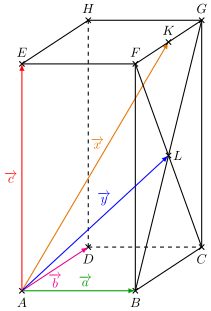
La imagen muestra un ortoedro \( ABCDEFGH \) con \( \overrightarrow{a} = \overrightarrow{AB} \), \( \overrightarrow{b} = \overrightarrow{AD} \), \( \overrightarrow{c} = \overrightarrow{AE} \), \( \overrightarrow{x} = \overrightarrow{AK} \) y \( \overrightarrow{y} = \overrightarrow{AL} \). \( K \) es el punto medio de \( FG \) y el punto \( L \) es el centro de la cara \( BCGF \). Expresa los vectores \( \overrightarrow{x} \) y \( \overrightarrow{y} \) como combinación lineal de los vectores \( \overrightarrow{a} \), \( \overrightarrow{b} \), \( \overrightarrow{c} \).
\( \overrightarrow{x} = \overrightarrow{a} + \frac12\overrightarrow{b} + \overrightarrow{c};\ \overrightarrow{y} = \overrightarrow{a} + \frac12\overrightarrow{b} + \frac12\overrightarrow{c} \)
\( \overrightarrow{x} = \frac12\overrightarrow{a} + \overrightarrow{b} + \frac12\overrightarrow{c};\ \overrightarrow{y} = \overrightarrow{a} - \frac12\overrightarrow{b} + \frac12\overrightarrow{c} \)
\( \overrightarrow{x} = \overrightarrow{a} + \frac12\overrightarrow{b} + \frac12\overrightarrow{c};\ \overrightarrow{y} = \overrightarrow{a} - \frac12\overrightarrow{b} + \frac12\overrightarrow{c} \)
\( \overrightarrow{x} = \overrightarrow{a} + \frac12\overrightarrow{b} + \frac12\overrightarrow{c};\ \overrightarrow{y} = \frac12\overrightarrow{a} + \frac12\overrightarrow{b} + \frac12\overrightarrow{c} \)

1103024302

Parte: 
A
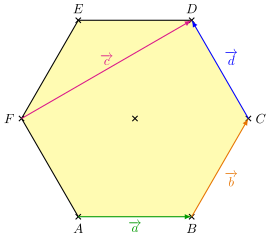
En el hexágono regular \( ABCDEF \) mostrado en la imagen, sean \( \overrightarrow{a} = \overrightarrow{AB} \), \( \overrightarrow{b} = \overrightarrow{BC} \), \( \overrightarrow{c} = \overrightarrow{FD} \) y \( \overrightarrow{d} = \overrightarrow{CD} \). Expresa los vectores \( \overrightarrow{c} \) y \( \overrightarrow{d} \) como combinación lineal de los vectores\( \overrightarrow{a} \) y \( \overrightarrow{b} \).
\( \overrightarrow{c} = \overrightarrow{a} + \overrightarrow{b};\ \overrightarrow{d} = \overrightarrow{b} - \overrightarrow{a} \)
\( \overrightarrow{c} = 2\overrightarrow{a} + 2\overrightarrow{b};\ \overrightarrow{d} = 2\overrightarrow{b} - 0.5\overrightarrow{a} \)
\( \overrightarrow{c} = 2\overrightarrow{a} + \overrightarrow{b};\ \overrightarrow{d} = \overrightarrow{b} - \overrightarrow{a} \)
\( \overrightarrow{c} = \overrightarrow{a} + \overrightarrow{b};\ \overrightarrow{d} = \overrightarrow{a} - \overrightarrow{b} \)