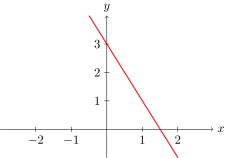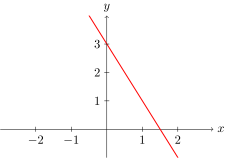
The function \(f(x) = 3 - 2x\)
is graphed in the picture. Consider the region between the graph of the function on the
interval \([ 0,\, 1.5] \)
and the axes. Determine the solid of revolution obtained by revolving this region about
\(y\)-axis
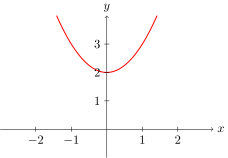
The function \(f(x) = x^{2} + 2\)
is graphed in the picture. Consider the region between the graph of the function on the interval
\([ 0,\, 1] \), both axes
and the line \(x = 1\).
Find the formula for the volume of the solid of revolution obtained by revolving this region
about \(y\)-axis.
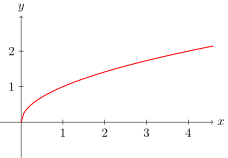
The function \(f(x)= \sqrt{x}\)
is graphed in the picture. Consider the region bounded by the graph of
\(f\) on
\([ 1,\, 4] \), lines
\(x = 1\),
\(x = 4\) and the
\(x\)-axis. Identify
the formula for volume of the solid of revolution obtained by revolving this region about
the \(x\)-axis.
Parabola is a set of the points that are equidistant from the point
(focus) and the line (directrix). Find the directrix of the parabola
\((x - 3)^{2} = 8y\).
The function \(f(x)= \sqrt{x}\)
is graphed in the picture. Consider the region bounded by the graph of
\(f\) on
\([ 1,\, 4] \), lines
\(x = 1\),
\(x = 4\) and the
\(x\)-axis.
Find the volume of the solid of revolution obtained by revolving this region about the
\(x\)-axis.
Parabola is a set of the points that are equidistant from the point
(focus) and the line (directrix). Find the directrix of the parabola
\((x + 2)^{2} = -8(y - 1)\).