Given points \(A = [0;1;2]\),
\(B = [1;2;0]\),
\(C = [1;2;3]\), find the angle
between the lines \(AB\)
and \(AC\).
Round your answer to the nearest degree.
Parabola is a set of the points that are equidistant from the point (focus)
and the line (directrix). Find the equation of the directrix of the parabola
\(P\colon x^{2} - 4x - 6y - 17 = 0\).
Find the angle between the \(x\)-axis
and the line \(p\).
\[
\begin{aligned}p\colon x& = 2 - t, &
\\y & = 3t,
\\z & = 1;\ t\in \mathbb{R}
\\ \end{aligned}
\]
Round your answer to the nearest minute.
Parabola is a set of the points that are equidistant from the point (focus)
and the line (directrix). Find the equation of the directrix of the parabola
\(P\colon y^{2} + 4y + 4x - 4 = 0\).
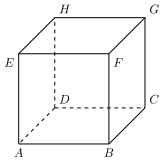
The points \(A = [0;5;0]\),
\(B = [5;5;0]\),
\(C = [5;0;0]\),
\(D = [0;0;0]\) define the cube
\(ABCDEFGH\). Find the angle
between the lines \(BF\)
and \(AC\).
Round your answer to the nearest minute.
Parabola is a set of the points that are equidistant from the point (focus)
and the line (directrix). Find the equation of the directrix of the parabola
\(P\colon x^{2} - 8x + 6y + 19 = 0\).
Find the angle between the planes \(\alpha \)
and \(\beta \).
\[
\alpha \colon 2x - 5y + 3z - 4 = 0,\qquad \beta \colon x - 3 = 0
\]
Round your answer to the nearest minute.
The general plane \(\alpha \)
has the equation
\[
\alpha \colon 3z - 4 = 0
\]
and the plane \(\beta \) has a
normal vector \(\vec{n} = (0;0;1)\). Find
the angle between \(\alpha \)
and \(\beta \)
and round your answer to the nearest degree.
Given points \(A = [1;0;2]\),
\(B = [1;0;0]\) and the
plane \(\alpha \),
\[
\alpha \colon 2x - 4y = 0,
\]
find the angle between the line \(AB\)
and the plane \(\alpha \).
Round your answer to the nearest minute.