Parabola is a set of the points that are equidistant from the point
(focus) and the line (directrix). Find the directrix of the parabola
\((x - 3)^{2} = 8y\).
Parabola is a set of the points that are equidistant from the point
(focus) and the line (directrix). Find the directrix of the parabola
\((x + 2)^{2} = -8(y - 1)\).
Parabola is a set of the points that are equidistant from the point
(focus) and the line (directrix). Find the directrix of the parabola
\((y - 4)^{2} = 8(x - 1)\).
Parabola is a set of the points that are equidistant from the point
(focus) and the line (directrix). Find the directrix of the parabola
\((y + 3)^{2} = -8(x + 4)\).
The function \(f(x)= \sqrt{x}\)
is graphed in the picture. Consider the region bounded by the graph of
\(f\) on
\([ 1;\, 4] \), lines
\(x = 1\),
\(x = 4\) and the
\(x\)-axis.
Find the volume of the solid of revolution obtained by revolving this region about the
\(x\)-axis.
The function \(f(x)= \sqrt{x}\)
is graphed in the picture. Consider the region bounded by the graph of
\(f\) on
\([ 1;\, 4] \), lines
\(x = 1\),
\(x = 4\) and the
\(x\)-axis. Identify
the formula for volume of the solid of revolution obtained by revolving this region about
the \(x\)-axis.
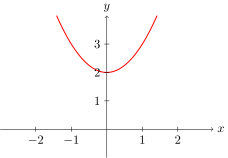
The function \(f(x)= x^{2} + 2\)
is graphed in the picture. Consider the region bounded by the graph of the function, both axes
and the line \(x = -1\).
Determine the solid of revolution obtained by revolving this region about
\(x\)-axis.
A general solid which is neither cone nor cylinder.
Suppose we are given the following equality of two fractions with nonzero denominators. From the given expressions, choose the one that by substituting to the starred position makes the equality true.
\[
\frac{3 - 2x}
{x - 2} = \frac{3(4x^{2} - 12x + 9)}
{*}
\]