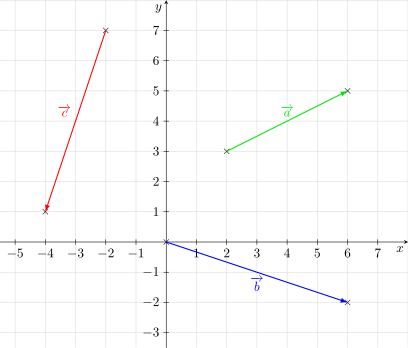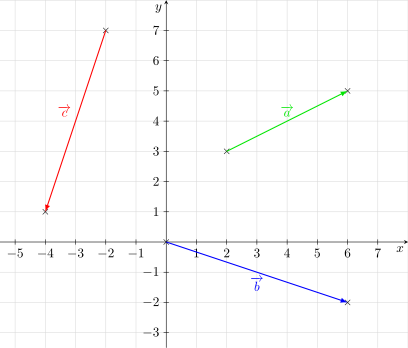
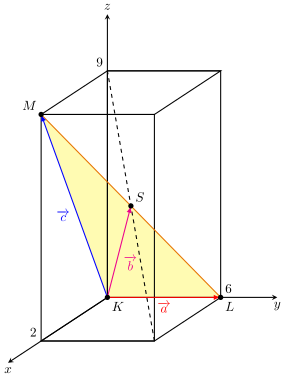
The picture shows the triangle \( KLM \) with indicated vectors \( \vec{a} \), \( \vec{b} \), \( \vec{c} \) in a coordinate system. What are the vector coordinates \( \vec{b} \)? Express \( \vec{b} \) as a linear combination of \( \vec{a} \) and \( \vec{c} \).
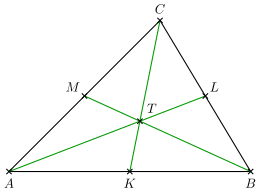
Given the vectors \( \vec{a} \), \( \vec{b} \), \( \vec{c} \) shown in the picture, express a vector \( \vec{b} \) as a linear combination of vectors \( \vec{a} \) and \( \vec{c} \).
Given the vectors \( \vec{a} \), \( \vec{b} \), and \( \vec{c} \) shown in the picture, express the vector \( \vec{c} \) as a linear combination of vectors \( \vec{a} \) and \( \vec{b} \).
We are given the points A = [-4,2,3], B = [-5,6,3], D = [1,1,4]. Find the coordinates of a point \( C \), if:
\[ \vec{u} = \overrightarrow{AB}\text{, }\ \overrightarrow{CD} = -\frac12\vec{u}\]
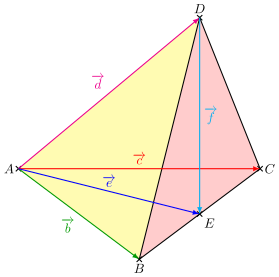
In a tetrahedron \( ABCD \), let \( \vec{b} = \overrightarrow{AB} \), \( \vec{c} = \overrightarrow{AC} \), \( \vec{d} = \overrightarrow{AD} \), \( \vec{e} = \overrightarrow{AE} \) and \( \vec{f} = \overrightarrow{DE} \). Further let \( E \) be the midpoint of \( BC \). Express vectors \( \vec{e} \) and \( \vec{f} \) as a linear combination of vectors \( \vec{b} \), \( \vec{c} \), \( \vec{d} \).
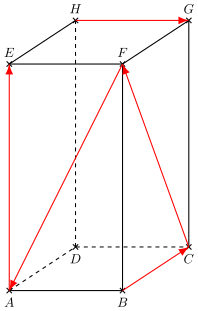
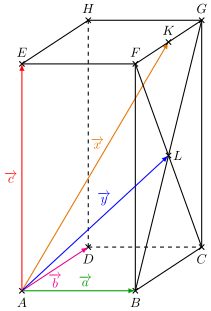
The picture shows a rectangular cuboid \( ABCDEFGH \). In the cuboid find the vector that is the sum of \( \overrightarrow{BC} + \overrightarrow{AE} + \overrightarrow{CF} + \overrightarrow{FA} + \overrightarrow{HG} \).
The picture shows a rectangular cuboid \( ABCDEFGH \) with \( \vec{a} = \overrightarrow{AB} \), \( \vec{b} = \overrightarrow{AD} \), \( \vec{c} = \overrightarrow{AE} \), \( \vec{x} = \overrightarrow{AK} \) and \( \vec{y} = \overrightarrow{AL} \). Point \( K \) is the midpoint of \( FG \) and point \( L \) is the centre of face \( BCGF \). Express vectors \( \vec{x} \) and \( \vec{y} \) as a linear combination of vectors \( \vec{a} \), \( \vec{b} \), \( \vec{c} \).
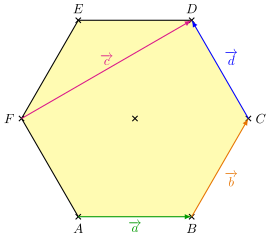
In a regular hexagon \( ABCDEF \) shown in the picture, let \( \vec{a} = \overrightarrow{AB} \), \( \vec{b} = \overrightarrow{BC} \), \( \vec{c} = \overrightarrow{FD} \) and \( \vec{d} = \overrightarrow{CD} \). Express vectors \( \vec{c} \) and \( \vec{d} \) as a linear combination of vectors \( \vec{a} \) and \( \vec{b} \).