A

1103030806

Level: 
A
The function \( f \) is given by the graph. Identify which of the following statements is false.
The function \( f \) is non-increasing in the interval \( [ -3;2 ] \).
The function \( f \) is not increasing.
The function \( f \) is decreasing in the interval \( [ 2;5 ] \).
The function \( f \) is non-decreasing in the interval \( [ -1;2 ] \).

1103030803

Level: 
A
There is a part of the graph of the function \( f(x)=x^3 \) in the picture. Identify which of the following statements is true.
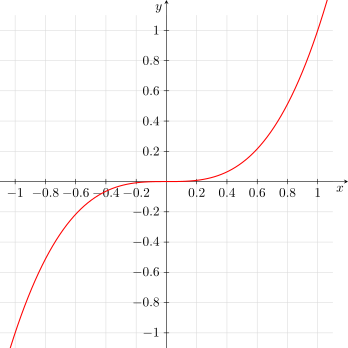
The function \( f \) is increasing in the interval \( [ -1;1 ] \).
The function \( f \) is decreasing in the interval \( [ -1;1 ] \).
The function \( f \) is non-decreasing and it is not increasing in the interval \( [ -1;1 ] \).
The function \( f \) is non-increasing in the interval \( [ -1;1 ] \).

1103030802

Level: 
A
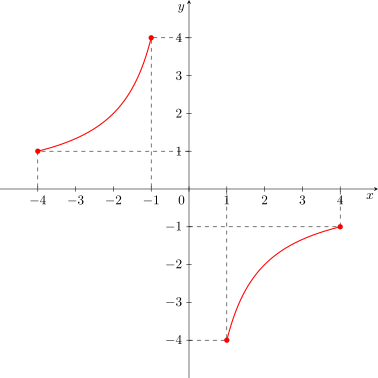
The function \( f \) is given by the graph. Identify which of the following statements is true.
The function \( f \) is neither increasing nor decreasing.
The function \( f \) is increasing.
The function \( f \) is non-decreasing.
The function \( f \) is increasing in the interval \( [ -4;1] \).

1003030801

Level: 
A
Suppose each of the following tables defines functions completely. Identify which of the tables represents the decreasing function.
\(\begin{array}{|c|c|c|c|c|c|c|c|} \hline x &-1 & -2 & 0 & -3 & 3 & 2 & 1 \\\hline f(x) & 3&4&-1&5&-5&-4&-3 \\\hline \end{array}\)
\(\begin{array}{|c|c|c|c|c|c|c|c|} \hline x &3 & 2 & 1 & 0 & -1 & -2 & -3 \\\hline h(x) & 5&4&3&2&0&-1&-2 \\\hline \end{array} \)
\(\begin{array}{|c|c|c|c|c|c|c|c|} \hline x &-3 & -2 & -1 & 0 & 1 & 2 & 3 \\\hline g(x) & 3&2&1&0&3&2&1 \\\hline \end{array} \)
\(\begin{array}{|c|c|c|c|c|c|c|c|} \hline x &-1 & -2 & 0 & -3 & 3 & 2 & 1 \\\hline m(x) & 3&4&-3&5&-5&-4&-3 \\\hline \end{array}\)

1003027712

Level: 
A
Compare two definite integrals \( I_1 = \int\limits_1^2 \frac1x\,\mathrm{d}x \) and \( I_2 = \int\limits_2^4 \frac1x\,\mathrm{d}x \).
\( I_1 \) is equal to \( I_2 \).
\( I_2 \) is twice as big as \( I_1 \).
\( I_1 \) is twice as big as \( I_2 \).
\( I_1 \) is \( 4 \) times as big as \( I_2 \).

1003027711

Level: 
A
Compare two definite integrals \( I_1 = \int\limits_0^5 0.6x\,\mathrm{d}x \) and \( I_2 = \int\limits_0^5 1.8x\,\mathrm{d}x \).
\( I_2 \) is \( 3 \) times as big as \( I_1 \).
\( I_1 \) is \( 3 \) times as big as \( I_2 \).
\( I_2 \) is \( 1.2 \) multiple of \( I_1 \).
\( I_2 \) is \( 30 \) times as big as \( I_ 1 \).