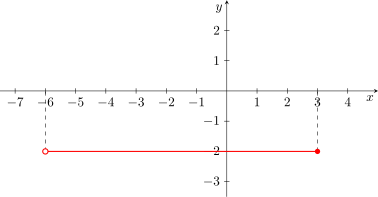
Every real number \( x \) can be written as \( x=c+d \), where \( c \) is an integer and \( d\in[0, 1) \). Then \( c \) is called the integer part of \( x \) and is denoted by \( [x] \). Which of the following functions has the biggest primitive period?
Let \( f \) be a periodic function with period \( 4 \). The diagram shows a part of the graph of \( f \). Identify which of the following statements is false.
The function \( f \) is an odd function.
The function \( f \) is increasing in the interval \( [14,15] \).
Let \( f \) be a periodic function with period \( 2.5 \). The diagram below shows a part of the graph of \( f \). Identify which of the following statements is false.
Let \( f \) be a periodic function with period \( 5 \). The table below shows some input and corresponding output values of \( f \).
\[\begin{array}{|c|c|c|c|c|c|c|c|} \hline x & -1.5 & -1 & 0 & 1 & 2 & 3 & 4 \\\hline f(x) & 0 & 4 & 1 & -1 & 3 & 2 & 4 \\\hline \end{array}\]
Identify which of the following statements is false.