Analytical space geometry

1003188907

Level: 
A
We are given two intersecting planes \( x-6y+9z-4=0 \) and \( x-2y+3z-4=0 \). Find the parametric equations of their line of intersection \( p \).
\( \begin{aligned} p\colon x&=4, \\ y&=\phantom{4+}\ 3t, \\ z&=\phantom{4+}\ 2t;\ t\in\mathbb{R} \end{aligned} \)
\( \begin{aligned} p\colon x&=4+t , \\ y&=\phantom{4+}\ 3t , \\ z&=\phantom{4+}\ 2t;\ t\in\mathbb{R} \end{aligned} \)
\( \begin{aligned} p\colon x&=4, \\ y&=\frac32+3t, \\ z&=1+2t;\ t\in\mathbb{R} \end{aligned} \)
\( \begin{aligned} p\colon x&=4+t, \\ y&=\frac32+3t, \\ z&=1+2t;\ t\in\mathbb{R} \end{aligned} \)

1003188906

Level: 
A
Let there be planes \( \alpha \), \( \beta \), \( \gamma \) and \( \delta \) defined by their general equations: \[ \begin{aligned} &\alpha\colon \frac23x-4y+6z-\frac83=0; \\ &\beta\colon x-2y+3z-4=0; \\ &\gamma\colon 2x-12y+18z-4 =0; \\ &\delta\colon x-6y+9z-4 =0. \end{aligned} \] Out of the following statements, select the one that is not true.
\( \alpha \parallel\delta\text{, }\alpha\neq\delta \)
Planes \( \beta \) and \( \delta \) are intersecting.
\( \gamma\parallel\delta\text{, }\gamma\neq\delta \)
Planes \( \alpha \) and \( \beta \) are intersecting.
\( \alpha = \delta \)

1003188905

Level: 
A
Determine the relative position of the plane \( \rho \) with general equation \( 5x-4y+z-4=0 \) and the straight line \( p \) with parametric equations: \[ \begin{aligned} x&=-1+t,\\ y&=2-2t,\\ z&=3+t;\ t\in\mathbb{R}. \end{aligned} \]
\( p \) is intersecting \( \rho \)
\( p\parallel \rho\text{, } p\not{\!\!\subset}\rho \)
\( p \subset \rho \)

1003188904

Level: 
A
Determine the relative position of the plane \( \rho \) with general equation \( 7x-2y+z-2=0 \) and the straight line \( p \) with parametric equations: \[ \begin{aligned} x&=3+t, \\ y&=-5-2t, \\ z&=3-11t;\ t\in\mathbb{R}. \end{aligned} \]
\( p\parallel \rho\text{, }p\not{\!\!\subset}\rho \)
\( p \subset \rho \)
\( p \) is intersecting the plane \( \rho \)

1003188903

Level: 
A
Determine the relative position of the plane \( \rho \) with general equation \( 2x-y+z-2=0 \) and the straight line \( p \) with parametric equations: \[ \begin{aligned} x&=2-t, \\ y&=5-2t, \\ z&=3;\ t\in\mathbb{R}. \end{aligned} \]
\( p \subset \rho \)
\( p\parallel\rho\text{, }p\not{\!\!\subset} \rho \)
\( p \) is intersecting the plane \( \rho \)

1103188902

Level: 
A
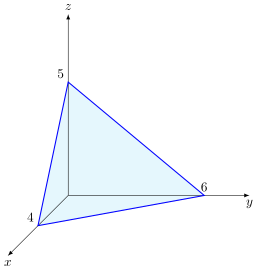
Assign the planes shown in the picture to the corresponding general equations.
\( \alpha\colon y-2=0;\ \beta\colon z-2=0;\ \gamma\colon x-2=0 \)
\( \alpha\colon y+2=0;\ \beta\colon z+2=0;\ \gamma\colon x+2=0 \)
\( \alpha\colon x+z-2=0;\ \beta\colon x+y-2=0;\ \gamma\colon y+z-2=0 \)
\( \alpha\colon x-y+z-2=0;\ \beta\colon x+y-z-2=0;\ \gamma\colon -x+y+z-2=0 \)

1103212206

Level: 
C
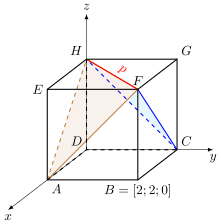
A cube \( ABCDEFGH \) with an edge length of \( 2 \) is placed in a coordinate system (see the picture). Let \( p \) be a line of intersection of planes \( \alpha \) and \( \beta \), where \( \alpha \) is passing through \( C \), \( F \) and \( H \) and \( \beta \) is passing through \( A \), \( F \) and \( H \). Find the parametric equations of the line \( p \) and calculate the angle \( \varphi \) between planes \( \alpha \) and \( \beta \) . Round \( \varphi \) to the nearest minute.
\( \begin{aligned} p\colon x&=t, & \varphi&\doteq 70^{\circ}32' \\ y&=t, & &\\ z&=2;\ t\in\mathbb{R}, & & \end{aligned} \)
\( \begin{aligned} p\colon x&=2t, & \varphi&\doteq 90^{\circ} \\ y&=2t, & & \\ z&=2+2t;\ t\in\mathbb{R}, & & \end{aligned} \)
\( \begin{aligned} p\colon x&=t, & \varphi&\doteq 90^{\circ}\\ y&=t, & & \\ z&=2;\ t\in\mathbb{R}, & & \end{aligned} \)
\( \begin{aligned} p\colon x&=2t, & \varphi&\doteq 70^{\circ}32' \\ y&=2t, & & \\ z&=2t;\ t\in\mathbb{R}, & & \end{aligned} \)

1103212205

Level: 
C
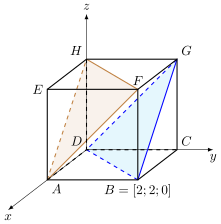
A cube \( ABCDEFGH \) with an edge length of \( 2 \) is placed in a coordinate system (see the picture). Find the distance between parallel planes \( \alpha \) and \( \beta \), where \( \alpha \) is passing through \( B \), \( D \) and \( G \) and \( \beta \) is passing through \( A \), \( F \) and \( H \).
\( |\alpha\beta|=\frac{2\sqrt3}3 \)
\( |\alpha\beta|=\frac{4\sqrt3}3 \)
\( |\alpha\beta|=\frac{3\sqrt3}2 \)
\( |\alpha\beta|=\frac{3\sqrt3}4 \)