Analytical space geometry

2010008707

Level: 
C
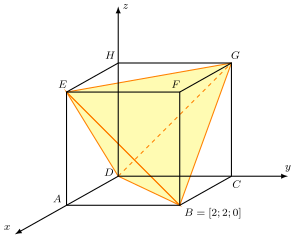
Let \(ABCDEFGH\) be a cube with an edge length of \(2\) units placed in the rectangular coordinate system. In the cube a regular tetrahedron \(BDEG\) is highlighted (see the picture). Find the angle between its faces and round the number to the nearest minute.
\(70^{\circ}32'\)
\(45^{\circ}0'\)
\(51^{\circ}4'\)
\(54^{\circ}44'\)

2010008706

Level: 
C
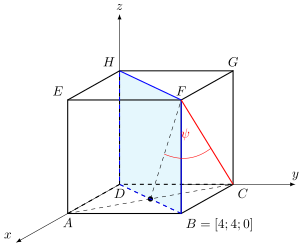
A cube \( ABCDEFGH \) with an edge length of \( 4 \) units is placed in a coordinate system (see the picture). Find an angle \( \psi \) between the plane \( \rho \) passing through the points \( B \), \( D \) and \( H \) and the straight line \( CF \). Hint: An angle between a line and a plane is an angle between the line and its orthogonal projection into this plane.
\( \psi = \frac{\pi}6 \)
\( \psi = \frac{\pi}{12} \)
\( \psi = \frac{\pi}4 \)
\( \psi = \frac{\pi}3 \)

2010008705

Level: 
C
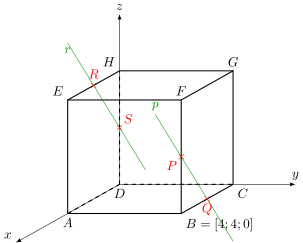
A cube \( ABCDEFGH \) with an edge length of \( 4 \) units is placed in a coordinate system (see the picture). Find the distance of parallel lines \( p=PQ\) and \( r=RS \), where points \( P \), \( Q \), \( R\) and \( S \) are midpoints of edges \(BF\), \(BC\), \(EH\) and \(DH\) respectively.
\( |pr|=2\sqrt6 \)
\( |pr|=4\sqrt3 \)
\( |pr|=6\sqrt2 \)
\( |pr|=4\sqrt2 \)

2010008704

Level: 
C
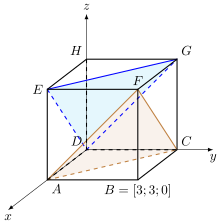
A cube \( ABCDEFGH \) with an edge length of \( 3 \) is placed in a coordinate system (see the picture). Find the distance between parallel planes \( \rho \) and \( \sigma \), where \( \rho \) is passing through \( D \), \( E \) and \( G \) and \( \sigma \) is passing through \( A \), \( C \) and \( F \).
\( |\rho\sigma|=\sqrt3 \)
\( |\rho\sigma|=\frac{2\sqrt3}3 \)
\( |\rho\sigma|=\frac{3\sqrt3}2 \)
\( |\rho\sigma|=\frac{4\sqrt3}3 \)

2010008703

Level: 
C
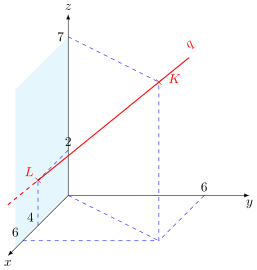
A straight line \( q \) is given by the points \( K=[6;6;7] \) and \( L=[4;0;2] \) (see the picture). Find the parametric equations of the line \( q' \) that is symmetrical to the line \( q \) in the plane symmetry across the coordinate \( xz \)-plane.
\( \begin{aligned} q'\colon x&=4+2t, \\ y&=-6t, \\ z&=2+5t;\ t\in\mathbb{R} \end{aligned} \)
\( \begin{aligned} q'\colon x&=4+6t, \\ y&=6t, \\ z&=2+7t;\ t\in\mathbb{R} \end{aligned} \)
\( \begin{aligned} q'\colon x&=4+2t, \\ y&=6t, \\ z&=2+5t;\ t\in\mathbb{R} \end{aligned} \)
\( \begin{aligned} q'\colon x&=4+6t, \\ y&=-6t, \\ z&=2+7t;\ t\in\mathbb{R} \end{aligned} \)

2010008702

Level: 
B
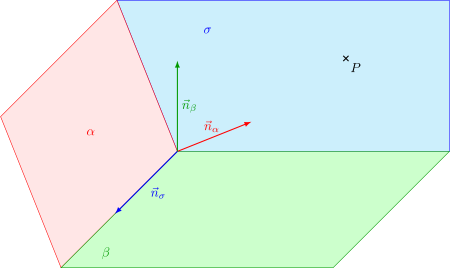
We are given the point \( P=[3;-4;-5] \) and planes \( \alpha \) by \( 2x-y-3z-5=0 \) and \( \beta \) by \( 3x-2y-4z+3=0 \). Find the general form of the equation of the plane \( \sigma \) which passes through the point \( P \) and is perpendicular to both planes \(\alpha\) and \(\beta\) (see the picture).
\( \sigma\colon 2x+y+z+3=0 \)
\( \sigma\colon 2x-y-z+15=0 \)
\( \sigma\colon 2x-y+z-5=0 \)
\( \sigma\colon 2x+y-z-7=0 \)

2010008701

Level: 
B
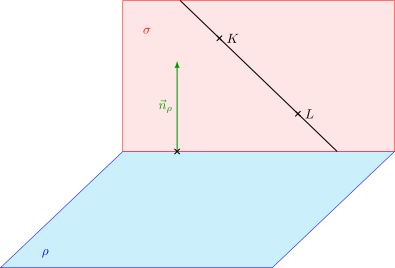
We are given the points \(K = [ 1; −2; 1]\), \(L = [2; 0; −3]\) and the plane \(\rho\) by \(x-2z+3=0\). Find the general form of the equation of the plane \(\sigma\) in which the line \(KL\) is located and is perpendicular to the plane \(\rho\) (see the picture).
\( \sigma\colon 2x+y+z-1=0 \)
\( \sigma\colon 2x+3y+2z+2=0 \)
\( \sigma\colon 2y+z+3=0 \)
\( \sigma\colon 2x+y-4=0 \)