B

9000020901

Parte: 
B
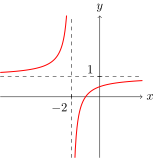
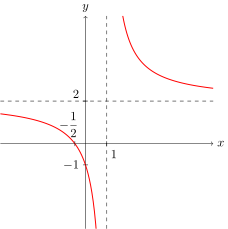
La solución del siguiente sistema de ecuaciones se puede interpretar como el punto de intersección de las curvas representadas en la imagen. Halla la solución del sistema en \(\mathbb{R}\times \mathbb{R}\). \[ \begin{alignedat}{80} &2x^{2} & - &3y &^{2} & = 2 &4 & & & & & & & & \\ &2x & - &3y & & = &0 & & & & & & & & \\\end{alignedat}\]
\([-6;-4],\ [6;4]\)
\([-6;-4]\)
\([6;4]\)
no tiene solución

9000019809

Parte: 
B
Halla la factorización de la siguiente ecuación. \[ x^{3} + 3x^{2} - x - 3 = 0 \]
\(\left (x + 3\right )\left (x + 1\right )\left (x - 1\right ) = 0\)
\(\left (x - 3\right )\left (x + 1\right )\left (x - 1\right ) = 0\)
\(\left (x + 3\right )\left (x - 3\right )\left (x - 1\right ) = 0\)
\(\left (x + 3\right )\left (x - 3\right )\left (x + 1\right ) = 0\)

9000019904

Parte: 
B
Dado el siguiente sistema matricial. Halla \(\mathop{\mathrm{rango}}(A)\) y \(\mathop{\mathrm{rango}}(A')\). \[ A = \begin{pmatrix} -1 & 3 & 2 \\ 0 & 4 & -5 \\ 0 & 0 & 2 \end{pmatrix} \qquad A' = \left(\begin{array}{ccc|c} -1 & 3 & 2 & 5 \\ 0 & 4 & -5 & 10\\ 0 & 0 & 2 & 0 \end{array}\right) \]
\(\mathop{\mathrm{rango}}(A) = 3,\ \mathop{\mathrm{rango}}(A') = 3\)
\(\mathop{\mathrm{rango}}(A) = 2,\ \mathop{\mathrm{rango}}(A') = 3\)
\(\mathop{\mathrm{rango}}(A) = 3,\ \mathop{\mathrm{rango}}(A') = 2\)
\(\mathop{\mathrm{rango}}(A) = 2,\ \mathop{\mathrm{rango}}(A') = 2\)

9000019810

Parte: 
B
Halla la factorización de la siguiente ecuación.. \[ 5x^{4} - 30x^{2} + 40 = 0 \]
\(5\left (x -\sqrt{2}\right )\left (x + \sqrt{2}\right )\left (x - 2\right )\left (x + 2\right ) = 0\)
\(\left (x -\sqrt{2}\right )\left (x + \sqrt{2}\right )\left (x - 2\right )\left (x + 2\right ) = 0\)
\(5x\left (x -\sqrt{2}\right )\left (x + \sqrt{2}\right )\left (x - 2\right ) = 0\)
\(5x\left (x -\sqrt{2}\right )\left (x + \sqrt{2}\right )\left (x + 2\right ) = 0\)

9000019905

Parte: 
B
Dado el sistema de tres ecuaciones con tres incógnitas. Halla el rango \((A)\) de la matriz del sistema \(A\) y el rango \((A')\) de la matriz aumentada del sistema \(A'\). \[ \begin{array}{cl} \phantom{ -} 3x + 5y +\phantom{ 2}z =\phantom{ -}10& \\ - 2x - 3y + 2z = -10& \\ \phantom{ - 2}x +\phantom{ 2}y - 5z =\phantom{ -}10& \end{array} \]
\(\mathop{\mathrm{rango}}(A) = 2,\ \mathop{\mathrm{rango}}(A') = 2\)
\(\mathop{\mathrm{rango}}(A) = 3,\ \mathop{\mathrm{rango}}(A') = 3\)
\(\mathop{\mathrm{rango}}(A) = 3,\ \mathop{\mathrm{rango}}(A') = 2\)
\(\mathop{\mathrm{rango}}(A) = 2,\ \mathop{\mathrm{rango}}(A') = 3\)

9000019906

Parte: 
B
Dado el sistema de cuatro ecuaciones con cuatro incógnitas. El rango de la matriz del sistema \(A\) es \(rango(A) = 3\), el rango de la matriz aumentada del sistema \(A'\) es \(rango(A') = 4\). ¿Cuántas soluciones tiene el sistema de ecuaciones?
no tiene solución
tiene infinitas soluciones
tiene solo una solución
no es posible hallar el número de soluciones

9000019907

Parte: 
B
La matriz aumentada de un sistema de tres ecuaciones con tres incógnitas equivale a la matriz \(A'\). Halla la solución del sistema. \[ A' = \left(\begin{array}{ccc|c} 1 & 2 & 4 & 0\\ 0 & 2 & 7 & 7\\ 0 & 0 & 7 & 35 \end{array}\right) \]
\([8;-14;5]\)
\([-62;21;5]\)
\([8;14;-5]\)
\([-22;-21;5]\)