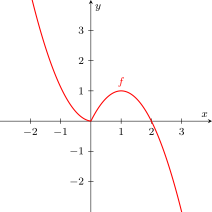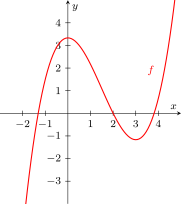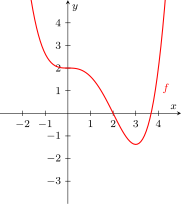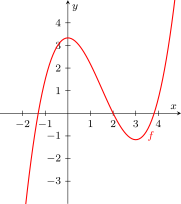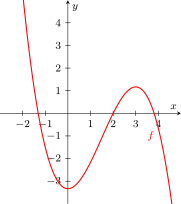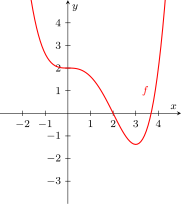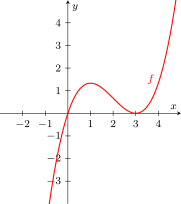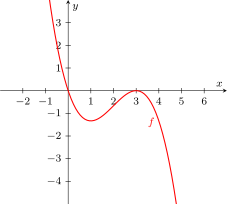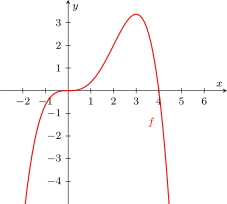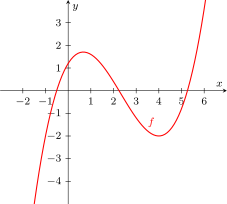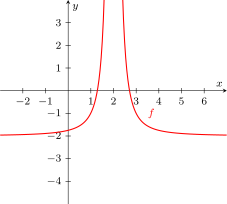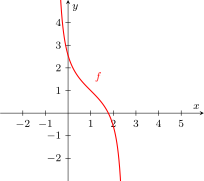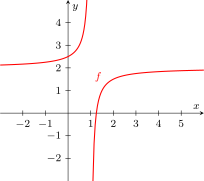
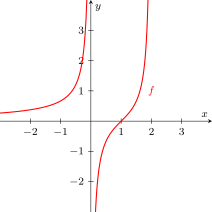
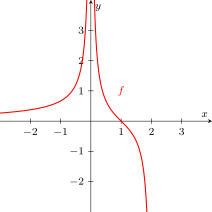
Wybierz wykres funkcji $f$, który spełnia
\begin{gather*}
f'(0) \text{ nie istnieje}; \\
f''(x) > 0 \text{ jeśli } x < 0 ; \\
f''(x) > 0 \text{ jeśli } x > 1; \\
f''(x) < 0 \text{ jeśli } 0 < x < 1
\end{gather*}
($f'$ jest pochodną funkcji $f$, $f''$ jest drugą pochodną funkcji $f$).
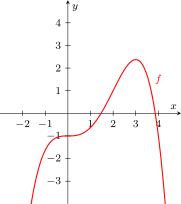
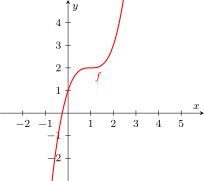
Wybierz wykres funkcji $f$, który spełnia
\begin{gather*}
f'(0)=f'(3)=0; \\
f''(0)=0;\ f''(3) < 0
\end{gather*}
($f'$ jest pochodną funkcji $f$, $f''$ jest drugą pochodną funkcji $f$).
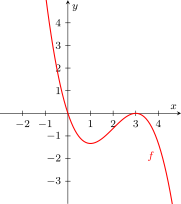
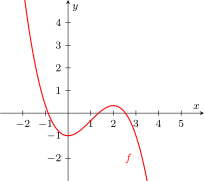
Wybierz wykres funkcji $f$ który, spełnia
\begin{gather*}
f'(0)=f'(3)=0; \\
f''(0) < 0;\ f''(3) > 0
\end{gather*}
($f'$ jest pochodną funkcji $f$, $f''$ jest drugą pochodną funkcji $f$).
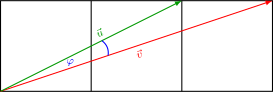
Na rysunku przedstawiono wektory $\vec{u}$ and $\vec{v}$ w trzech kwadratach. Oblicz miarę kąta $\varphi$ pomiędzy $\vec{u}$ i $\vec{v}$. Zaokrągli $\varphi$ do pełnych stopni.
Wskazówka: utworzenie układu współrzędnych ułatwi zadanie.