Identify the optimal first step to solve the following equation. The operation is
intended to be used on both sides of the equation.
\[
\frac{4 + x}
{x + 1} = \frac{x - 3}
{x + 2}
\]
multiply by \((x + 2)\cdot (x + 1)\),
assuming \(x\neq - 2\)
and \(x\neq - 1\)
multiply by \((4 + x)\cdot (x - 3)\),
assuming \(x\neq - 4\)
and \(x\neq 3\)
multiply by \((4 + x)\cdot (x + 1)\),
assuming \(x\neq - 4\)
and \(x\neq - 1\)
multiply by \((x - 3)\cdot (x + 2)\),
assuming \(x\neq 3\)
and \(x\neq - 2\)
Identify the optimal first step to solve the following equation. The
operation is intended to be used on both sides of the equation. Assume
\(x\neq 1\) and
\(x\neq 2\).
\[
\frac{1}
{x - 1} = \frac{2}
{x - 2}
\]
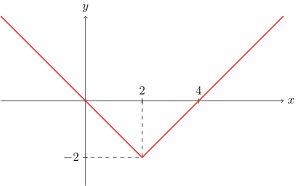
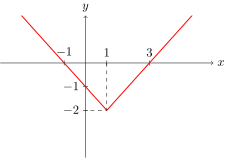
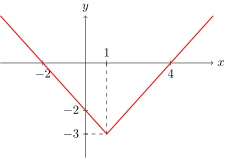
Identify the value of real parameters \(a\)
and \(b\)
such that the graph of the function
\[
f(x) = \left |x - a\right | + b
\]
corresponds to the picture.
Identify the optimal first step to solve the following equation. The operation is
intended to be used on both sides of the equation.
\[
\frac{2x + 1}
{x - 1} + \frac{x + 1}
{x - 1} = \frac{11}
{2}
\]
multiply by \(2(x - 1)\),
assuming \(x\neq 1\)
multiply by \((2x + 1)\),
assuming \(x\neq -\frac{1}
{2}\)
multiply by \((x + 1)\),
assuming \(x\neq - 1\)
multiply by \(\frac{1}
{2x+1}\),
assuming \(x\neq -\frac{1}
{2}\)
multiply by \(\frac{1}
{x+1}\),
assuming \(x\neq - 1\)
multiply by \(2(2x + 1)(x + 1)\),
assuming \(x\neq -\frac{1}
{2}\)
and \(x\neq - 1\)
Consider the equation
\[
\sqrt{x^{2 } - 2x + 1} = x + 2
\]
and the equation which arises from this equation by squaring both sides of the
equation, i.e. the equation
\[
\left (\sqrt{x^{2 } - 2x + 1}\right )^{2} = (x + 2)^{2}.
\]
Identify a true statement.
Both equations are equivalent only if
\(x\geq - 2\).
Both equations are equivalent.
Both equations are equivalent only if
\(x\leq - 2\).
Removing radical in an equation by squaring both sides may enrich the set of
solutions of this equation and checking the solutions of the new equation in the
original equation may be necessary. Identify a correct conclusion in the particular
case of the following equation.
\[
-\sqrt{x^{2 } - 2x + 1} = x
\]
If we look for the solution in the set
\(\mathbb{R}^{-}\), then
squaring both sides of the equation gives an equivalent equation. The checking of the
solution is not necessary.
If we look for the solution in the set
\(\mathbb{R}^{+}\), then
squaring both sides of the equation gives an equivalent equation. The checking of the
solution is not necessary.
If we look for the solution in the set
\(\mathbb{R}\), then
squaring both sides of the equation gives an equivalent equation. The checking of the
solution is not necessary.