Identify the optimal first step to solve the following equation. The operation is
intended to be used on both sides of the equation.
\[
x + \frac{x}
{6} = \frac{x}
{15} + 1
\]
Let \([x,y]\)
be the solution of the system
\[\begin{aligned}
2x - y & = -1, & &
\\4x - y & = 1. & &
\end{aligned}\]
In the following list identify a true statement.
Identify the optimal first step to solve the following equation. The operation is
intended to be used on both sides of the equation.
\[
\frac{x + 5}
{9} -\frac{x}
{6} = \frac{x - 2}
{9} + \frac{x - 3}
{9}
\]
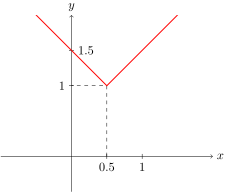
Identify the value of a real parameter \(b\)
such that the graph of the function
\[
f(x) = \left |x + \frac{1}
{2}\right | + b
\]
corresponds to the picture.
Let \([x,y]\)
be the solution of the system
\[\begin{aligned}
2x + 3y & = 0, & &
\\3x + 2y & = 5. & &
\end{aligned}\]
In the following list identify a true statement.
Identify the optimal first step to solve the following equation. The operation is
intended to be used on both sides of the equation.
\[
5x = \frac{2 + x}
{5}
\]
multiply by \(5\)
multiply by \(\frac{1}
{5}\)
multiply by \(\frac{1}
{2}\)
multiply by \(2\)
multiply by \(\frac{1}
{x}\),
assuming \(x\neq 0\)
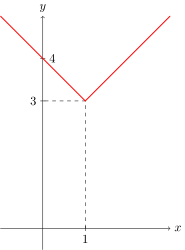
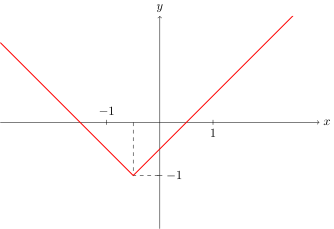
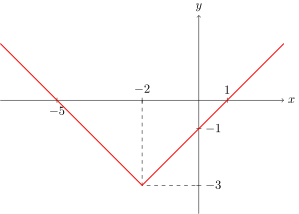
Identify the value of real parameters \(a\)
and \(b\)
such that the graph of the function
\[
f(x)= \left |x + a\right | + b
\]
corresponds to the picture.