A

1103028409

Level: 
A
The function \( f \) is given by the graph. Which of the statements about the domain and the range of the function \( f \) is true?
\( D(f) =[-3,4], H(f)=[-2,2)\cup(2, 3]\cup\{5\} \)
\( D(f) =[-3,1)\cup(1, 4], H(f)=[-2, 2)\cup(2, 3] \)
\( D(f)=[-3,4], H(f)=[-2,5] \)
\( D(f) =[-3,4], H(f)=[-2,3]\cup\{5\} \)

1003028406

Level: 
A
Suppose the function \( f \) is given completely by the next table. \[ \begin{array}{|c|c|c|c|c|c|c|c|}\hline x&-3&-2&-1&0&1&2&3 \\\hline y&-4&4&-4&4&-4&4&-4 \\\hline \end{array} \] Which of the following statements about the range of the function \( f \) is true?
\( H(f)=\{-4, 4\} \)
\( H(f)=\{-3,-2,-1,0,1,2,3\} \)
\( H(f)=[-4,4] \)
\( H(f)=(-4,4) \)

1003028405

Level: 
A
Suppose the function \( f \) is given completely by the next table. \[ \begin{array}{|c|c|c|c|c|c|c|c|} \hline x&-2&-1& 0&1&2&3&4\\\hline y&0&1&0&2&3&5&4 \\\hline \end{array} \] Which of the following statements about the domain of the function \( f \) is true?
\( D(f)=\{-2, -1,0,1,2,3,4\} \)
\( D(f)=\{0,1,2,3,4,5\} \)
\( D(f)=\{-2,-1,0,1,2,3,4,5\} \)
\( D(f)=[-2,4] \)

1103020804

Level: 
A
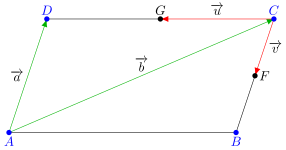
In the parallelogram \( ABCD \) shown in the picture, \( G \) is the midpoint of \( CD \), \( F \) is the midpoint of \( BC \) and \( \vec{u}=\overrightarrow{CG} \), \( \vec{v}=\overrightarrow{CF} \), \( \vec{a}=\overrightarrow{AD} \) and \( \vec{b}=\overrightarrow{AC} \). Express vectors \( \vec{a} \) and \( \vec{b} \) as a linear combination of vectors \( \vec{u} \) and \( \vec{v} \).
\( \vec{a}=-2\vec{v},\ \vec{b}=-2\vec{u}-2\vec{v} \)
\( \vec{a}=\vec{b}+2\vec{u},\ \vec{b}=-2\vec{u}+2\vec{v} \)
\( \vec{a}=\vec{b}-2\vec{u},\ \vec{b}=-\sqrt2\vec{u}-\sqrt2\vec{v} \)
\( \vec{a}=-2\vec{v},\ \vec{b}=2\vec{u}+2\vec{v} \)