Triangles

9000038701

Level: 
C
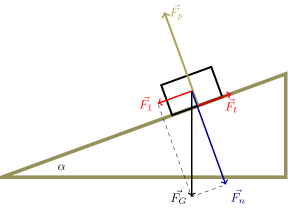
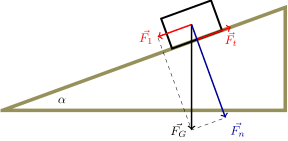
The box is on the slope as in the picture. The angle of the slope is \(\alpha \). The forces acting on the box are the force of gravity \(\vec{F_{G}}\) and the friction \(\vec{F_{t}}\). The force of gravity can be replaced by two components \(\vec{F_{1}}\) and \(\vec{F_{n}}\). (The force \(\vec{F_{1}}\) is parallel to the slope and \(\vec{F_{n}}\) is perpendicular to the slope.) The friction \(F_{t}\) is given by the formula \(F_{t} = fF_{n}\), where \(f\) is the coefficient of the friction.What is the influence of the increasing angle \(\alpha \) on the forces acting on the box?
\(F_{1}\) becomes bigger and \(F_{t}\) becomes smaller
both \(F_{1}\) and \(F_{t}\) become smaller
\(F_{1}\) becomes bigger, \(F_{t}\) does not change
\(F_{1}\) becomes smaller, \(F_{t}\) does not change
both \(F_{1}\) and \(F_{t}\) become bigger
\(F_{1}\) becomes smaller and \(F_{t}\) becomes bigger
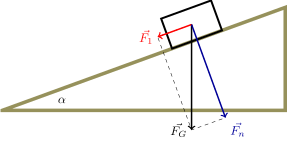
9000038702

Level: 
C
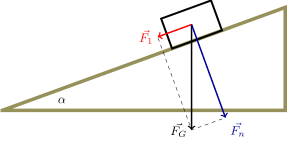
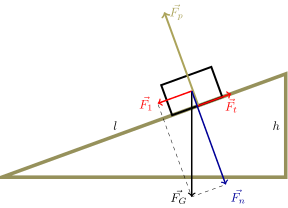
The box is on the slope as in the picture. The angle of the slope is \(\alpha \). The forces acting on the box are the force of gravity \(\vec{F_{G}}\) and the friction \(\vec{F_{t}}\). The force of gravity can be replaced by two components \(\vec{F_{1}}\) and \(\vec{F_{n}}\). (The force \(\vec{F_{1}}\) is parallel to the slope and \(\vec{F_{n}}\) is perpendicular to the slope.) Find \(F_{1}\).
\(F_{1} = F_{G}\sin \alpha \)
\(F_{1} = \frac{F_{G}} {\sin \alpha } \)
\(F_{1} = F_{G}\mathop{\mathrm{tg}}\nolimits \alpha \)
\(F_{1} = \frac{F_{G}} {\mathop{\mathrm{tg}}\nolimits \alpha } \)
\(F_{1} = F_{G}\cos \alpha \)
\(F_{1} = \frac{F_{G}} {\cos \alpha } \)

9000038703

Level: 
C
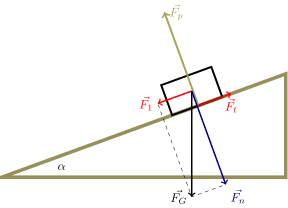
The box is on the slope as in the picture. The angle of the slope is \(\alpha \). The forces acting on the box are the force of gravity \(\vec{F_{G}}\) and the friction \(\vec{F_{t}}\). The force of gravity can be replaced by two components \(\vec{F_{1}}\) and \(\vec{F_{n}}\). (The force \(\vec{F_{1}}\) is parallel to the slope and \(\vec{F_{n}}\) is perpendicular to the slope.) Find \(F_{p}\).
\(F_{p} = F_{G}\cos \alpha \)
\(F_{p} = \frac{F_{G}} {\cos \alpha } \)
\(F_{p} = F_{G}\mathop{\mathrm{tg}}\nolimits \alpha \)
\(F_{p} = \frac{F_{G}} {\mathop{\mathrm{tg}}\nolimits \alpha } \)
\(F_{p} = F_{G}\sin \alpha \)
\(F_{p} = \frac{F_{G}} {\sin \alpha } \)

9000038704

Level: 
C
The box is on the slope as in the picture. The angle of the slope is \(\alpha \). The forces acting on the box are the force of gravity \(\vec{F_{G}}\) and the friction \(\vec{F_{t}}\). The force of gravity can be replaced by two components \(\vec{F_{1}}\) and \(\vec{F_{n}}\). (The force \(\vec{F_{1}}\) is parallel to the slope and \(\vec{F_{n}}\) is perpendicular to the slope.) For \(F_{1} = 20\, \mathrm{N}\) and \(F_{n} = 55\, \mathrm{N}\) find the corresponding \(\alpha \).
\(\alpha \doteq 20^{\circ }\)
\(\alpha \doteq 21^{\circ }\)
\(\alpha \doteq 69^{\circ }\)
\(\alpha \doteq 70^{\circ }\)
\(\alpha \doteq 30^{\circ }\)
\(\alpha \doteq 29^{\circ }\)

9000038705

Level: 
C
The box is on the slope as in the picture. The angle of the slope is \(\alpha = 45^{\circ }\). The forces acting on the box are the force of gravity \(\vec{F_{G}}\) and the friction \(\vec{F_{t}}\). The force of gravity can be replaced by two components \(\vec{F_{1}}\) and \(\vec{F_{n}}\). (The force \(\vec{F_{1}}\) is parallel to the slope and \(\vec{F_{n}}\) is perpendicular to the slope.) The friction \(F_{t}\) is given by the formula \(F_{t} = fF_{n}\). The coefficient of the friction \(f = 0.5\). Consider the standard acceleration of gravity \(g = 10\, \mathrm{m\, s^{-2}}\). Find the acceleration of the box.
\(a = \frac{5\sqrt{2}} {2} \, \mathrm{m\, s^{-2}}\)
\(a = 5\sqrt{2}\, \mathrm{m\, s^{-2}}\)
\(a = 5\sqrt{3}\, \mathrm{m\, s^{-2}}\)
\(a = 0\, \mathrm{m\, s^{-2}}\)
\(a = 5\, \mathrm{m\, s^{-2}}\)
\(a = \frac{5\sqrt{3}} {2} \, \mathrm{m\, s^{-2}}\)

9000038706

Level: 
C
The box is on the slope as in the picture. The angle of the slope is \(\alpha \). The forces acting on the box are the force of gravity \(\vec{F_{G}}\) and the friction \(\vec{F_{t}}\). The force of gravity can be replaced by two components \(\vec{F_{1}}\) and \(\vec{F_{n}}\). (The force \(\vec{F_{1}}\) is parallel to the slope and \(\vec{F_{n}}\) is perpendicular to the slope.) The friction \(F_{t}\) is given by the formula \(F_{t} = fF_{n}\). The coefficient of the friction is \(f = 0.47\). Consider the standard acceleration of gravity \(g = 10\, \mathrm{m\, s^{-2}}\). Find the angle \(\alpha \) which ensures that the box moves on the slope with zero acceleration.
\(\alpha \doteq 25^{\circ }\)
\(\alpha \doteq 15^{\circ }\)
\(\alpha \doteq 20^{\circ }\)
\(\alpha \doteq 65^{\circ }\)
\(\alpha \doteq 28^{\circ }\)
\(\alpha \doteq 62^{\circ }\)

9000038707

Level: 
C
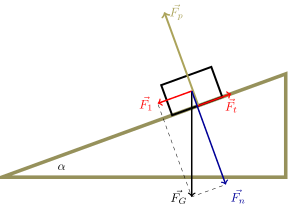
The box is on the slope as in the picture. The length of the slope is \(l = 2\, \mathrm{m}\) and the height is \(h = 1.2\, \mathrm{m}\). The forces acting on the box are the force of gravity \(\vec{F_{G}}\) and the friction \(\vec{F_{t}}\). The force of gravity can be replaced by two components \(\vec{F_{1}}\) and \(\vec{F_{n}}\). (The force \(\vec{F_{1}}\) is parallel to the slope and \(\vec{F_{n}}\) is perpendicular to the slope.) The friction \(F_{t}\) is given by the formula \(F_{t} = fF_{n}\) where \(f\) is the coefficient of the friction. Consider the standard acceleration of gravity \(g = 10\, \mathrm{m\, s^{-2}}\). Find the minimal value for the coefficient of the friction \(f\) to ensure that the box does not move with an acceleration.
\(f = 0.75\)
\(f = 0.6\)
\(f = 0.65\)
\(f = 0.7\)
\(f = 0.55\)
\(f = 0.8\)

9000036107

Level: 
C
There are three information panels \(A\), \(B\) and \(C\) in the park. The direct distance between \(B\) and \(C\) is \(150\, \mathrm{m}\). The visual angle of this distance from the panel \(A\) is \(55^{\circ }\). The visual angle of the distance \(AC\) from the panel \(B\) is \(39^{\circ }\). Find the direct distance between the panels \(A\) and \(B\) and round your answer to nearest meters.
\(183\, \mathrm{m}\)
\(147\, \mathrm{m}\)
\(195\, \mathrm{m}\)
\(218\, \mathrm{m}\)

9000036108

Level: 
C
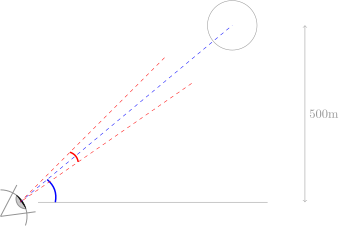
The center of a spherical balloon is at a height of \(500\, \mathrm{m}\) height. The visual angle of the balloon is \(1^{\circ }30'\). The elevation angle of the center of the balloon is \(42^{\circ }50'\). Find the diameter of the balloon in meters and round to nearest one decimal.
\(19.3\, \mathrm{m}\)
\(18.2\, \mathrm{m}\)
\(18.9\, \mathrm{m}\)
\(19.5\, \mathrm{m}\)

9000036109

Level: 
C
The point \(A\) is located \(20\, \mathrm{cm}\) from a mirror and the point \(B\) is located \(50\, \mathrm{cm}\) from the same mirror. The direct distance between \(A\) and \(B\) (the length of the segment \(AB\)) is \(70\, \mathrm{cm}\). Find the angle of incidence of the ray through the point \(A\) which is reflected to the point \(B\) and round your answer to nearest degrees. (The angle of incidence is the angle between the incident ray and the normal to the mirror.)
\(42^{\circ }\)
\(37^{\circ }\)
\(38^{\circ }\)
\(48^{\circ }\)