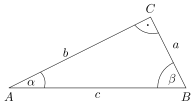
Consider an isosceles triangle \(ABC\) with sides \(AC\) and \(BC\) of equal length. The measure of the angle \( BAC\) is \(40^{\circ }\). \(X\) is the point of intersection between the line $AB$ and the line through the vertex \(C\) perpendicular to it. Find the measure of the angle \( BCX\).
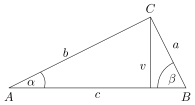
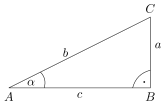
Given a right triangle \(ABC\) with the right angle at $C$ and an altitude $v$ (see the picture). Find the
valid relation between the angle \(\alpha \)
and the lengths in the triangle.
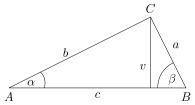
Given a right triangle \(ABC\) with the right angle at $C$ and an altitude $v$ (see the picture). Find the
valid relation between the angle \(\beta \)
and the lengths in the triangle.
Consider an isosceles triangle, i.e. the triangle with two
sides of equal length. The length of the third side is
\(4\, \mathrm{cm}\). One of the
interior angles is \(120^{\circ }\).
Find the area of this triangle.
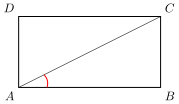
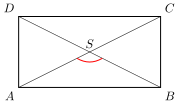
Consider the rectangle \(ABCD\)
with length and height \(|AB| = 6\, \mathrm{cm}\)
and \(|BC| = 2\sqrt{3}\, \mathrm{cm}\), respectively.
Find the measure of the angle \( CAB\).
Consider the rectangle \(ABCD\)
with length and height \(|AB| = 6\, \mathrm{cm}\)
and \(|BC| = 2\sqrt{3}\, \mathrm{cm}\). Let
\(S\) be the intersection of
diagonals. Find the angle \(\measuredangle ASB\).