Rational functions

1003108603

Level: 
A
The fuel consumption of Skoda Fabia \( 1.4 \) MPi/\( 44\,\mathrm{kW} \) stated by the manufacturer varies between \( 5.5\,\mathrm{l} \) / \( 100\,\mathrm{km} \) (out of a town) to \( 9.6\,\mathrm{l} \) / \( 100\,\mathrm{km} \) (in a town). Suppose the car’s fuel tank of capacity \( 45\,\mathrm{l} \) is filled completely. Choose the function describing relation between the distance \( p \) in \( \mathrm{km} \) that the car can travel without tanking on the fuel consumption \( s \).
\( f\colon p=\frac{4\:500}s;\ s\in[5.5;9.6] \)
\( h\colon p=\frac{45}s;\ s\in[5.5;9.6] \)
\( r\colon p=\frac s{0.45};\ s\in[5.5;9.6] \)
\( g\colon p=45\cdot s;\ s\in[5.5;9.6] \)

1103108602

Level: 
A
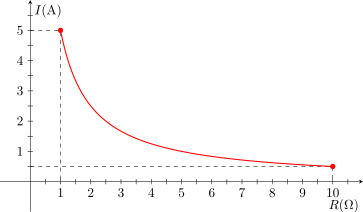
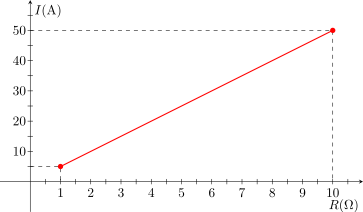
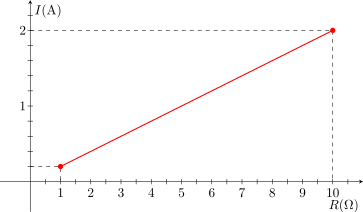
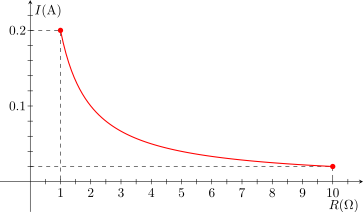
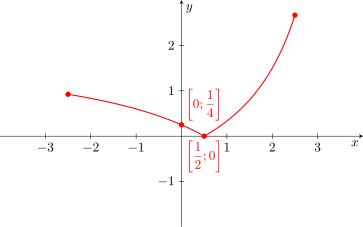
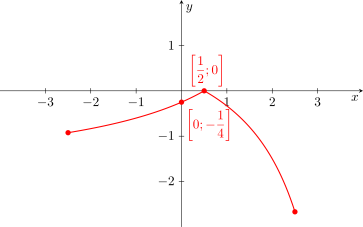
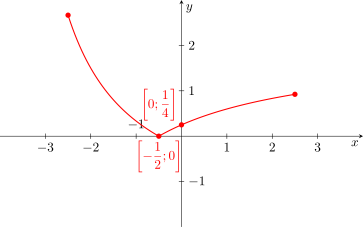
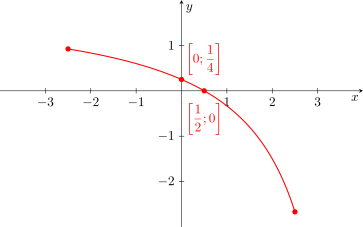
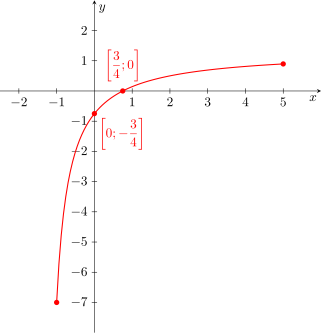
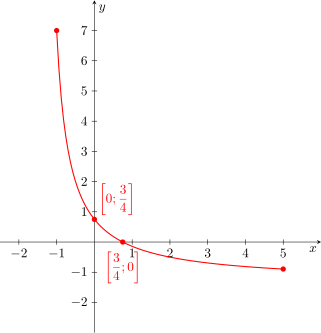
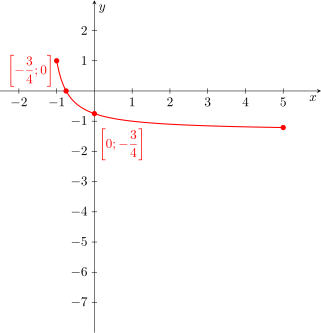
In a simple electric circuit a voltage source and a variable resistor with resistance \( R \) in the range \( [1\Omega;10\Omega] \) are connected. Suppose the source gives fixed voltage of \( 5\,\mathrm{V} \). From the graphs given below select the one that describes the dependence of the electric current \( I \) on the resistance \( R \) in this circuit. (Note: The relationship between electric currant, voltage and resistance is described by Ohm’s law: \( U=RI \).)

1003108601

Level: 
A
Peter drove from Ostrava to Warsaw. He drove at an average speed of \( 104 \) kilometres per hour and reached Warsaw in \( 4 \) hours. Select the function that describes the dependence of Peter’s driving time \( t \) on the average speed \( v \) of the car. (The driving time \( t \) is given in hours and the average speed \( v \) is given in kilometres per hour.)
\( t=\frac{416}v\text{ ,}\ v\in(0;\infty) \)
\( t=\frac{26}v\text{ ,}\ v\in(0;\infty) \)
\( t=\frac v{26}\text{ ,}\ v\in(0;\infty) \)
\( t=\frac{104}v\text{ ,}\ v\in(0;\infty) \)

1103124503

Level: 
A
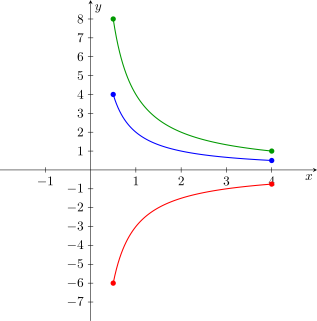
The picture shows graphs of functions: \[ \begin{aligned} f(x)&=\frac2x\text{, }x\in\left[\frac12;4\right], \\ g(x)&=\frac{-3}x\text{, }x\in\left[\frac12;4\right], \\ h(x)&=\frac4x\text{, }x\in\left[\frac12;4\right]. \end{aligned} \] Choose the correct statement.
The function \( f \) is graphed in blue and the function \( h \) is graphed in green.
The function \( g \) is graphed in red and the function \( f \) is graphed in green.
The function \( f \) is graphed in green and the function \( h \) is graphed in blue.
The function \( g \) is graphed in green and the function \( f \) is graphed in blue.