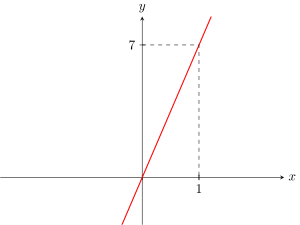
Linear functions

2000003109

Level: 
C
In the morning at \(7\,\mathrm{a.m.}\) we measured \(3^\circ\mathrm{C}\), at \(10\,\mathrm{a.m.}\) we measured \(12^\circ \mathrm{C}\). How many degrees was at \(9\,\mathrm{a.m.}\), if we assume that the temperature rose linearly?
\(9^\circ\mathrm{C}\)
\(10^\circ\mathrm{C}\)
\(8^\circ\mathrm{C}\)
\(6^\circ\mathrm{C}\)

2000003108

Level: 
A
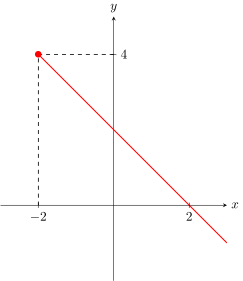
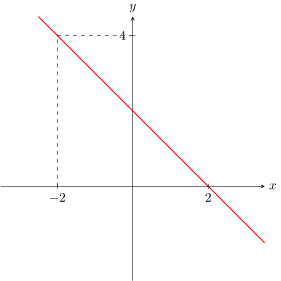
There is a graph of a function \(f\) in the picture. The function \(f\) is restriction of a linear function such that the domain of \(f\) is \([ -2;\infty)\). What are properties of \(f\)?
The function \(f\) is bounded above, injective (one-to-one) and decreasing.
The function \(f\) has maximum and minimum, is decreasing and bounded.
The function \(f\) is odd, decreasing and has maximum.
The function \(f\) does not have minimum, is even and bounded above.

2000003103

Level: 
A
Which of the functions \(f\), \(g\), \(h\), \(k\), \(m\), \(n\) are decreasing, have minimum and are bounded functions? \[f (x)=-3,~x \in \mathbb{R}\] \[g (x)=-0.3x-3,~x \in [ 0;6 ]\] \[h (x)=-0.4x+5,~x \in (-\infty ;3 ]\] \[k (x)=3x+2,~x \in [ -3;5)\] \[m (x)=-12x+4,~x \in [ 0;\infty)\] \[n (x)=-2x+4,~x \in (0;7 ]\]
\(g\), \(n\)
\(f\), \(g\), \(h\), \(m\), \(n\)
\(g\)
\(k\), \(n\)