Linear functions

1103171502

Level: 
B
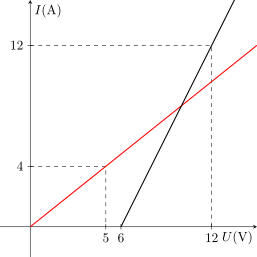
Current-Voltage characteristic of a conductor is a relationship, usually represented as a graph, between the current \( I \) through the conductor and the voltage \( U \) across the conductor. The picture shows two characteristics: of a metal conductor (red colour) and of an electrolytic conductor (black colour). At what voltages need to be conductors connected so that the current is the same in both of them?
\( 10\,\mathrm{V} \)
\( 16\,\mathrm{V} \)
\( 8\,\mathrm{V} \)
\( 9.5\,\mathrm{V} \)
1103171501

Level: 
C
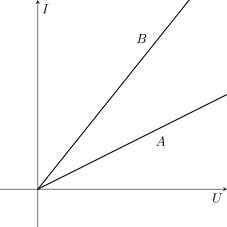
Ohm's law states that the current \( I \) through a conductor is directly proportional to the voltage \( U \) between the endpoints of the conductor. This relationship is described by the equation \( I=\frac UR \), where \( R \) is the resistance of the conductor. Current-voltage characteristics of the conductors \( A \) and \( B \) are in the picture. Which of the conductors has greater resistance?
\( A \)
\( B \)
Both conductors have the same resistance.
It is not possible to answer the question based on the graph.

1003171301

Level: 
C
The freezing point and the boiling point of water (both under the normal atmospheric pressure) are the base of the most commonly used temperature scale around Europe. It is Celsius temperature scale in Celsius degrees (\( ^{\circ}\mathrm{C} \)). Fahrenheit temperature scale in Fahrenheit degrees (\( ^{\circ}\mathrm{F} \)) is of general common use in English speaking countries especially in the USA. The basic temperature points in mentioned scales have the values: \[ \begin{array}{l} \text{Water freezing point } \dots\ 0\,^{\circ}\mathrm{C} / 32\,^{\circ}\mathrm{F} \\ \text{Water boiling point } \dots\ 100\,^{\circ}\mathrm{C} / 212\,^{\circ}\mathrm{F} \end{array} \] From the following equations choose the one that can be used to convert a temperature from its Celsius representation to the Fahrenheit value, provided you know that the relationship between the scales is linear. (In equations, \( F \) is a numerical value of a temperature in Fahrenheits and \( C \) is a numerical value of a temperature in Celsius.)
\( F=\frac95 C+32 \)
\( F=\frac59C+32 \)
\( F=\frac59 C-\frac{160}9 \)
\( F=32C+100 \)

1003160903

Level: 
C
The graph of a linear function \( f \) passes through the point \( \left[4\sqrt3;2\right] \) and it makes an angle of \( 30^{\circ} \) with the positive direction of \( x \)-axis measured anticlockwise. Choose the correct form of the function \( f \), such that the given property is preserved.
\( f(x)=\frac{\sqrt3}3x-2 \)
\( f(x)=\sqrt3x-10 \)
\( f(x)=\frac{\sqrt3}3x+2 \)
\( f(x)=\sqrt3x+10 \)

1003160902

Level: 
C
Suppose \( f \) is a linear function. If the value of the independent variable \( x \) increases by \( 4 \), the function value decreases by \( 12 \). Choose the correct form of the function \( f \), such that the given property is preserved.
\( f(x)=-3x \)
\( f(x)=3x \)
\( f(x)=3x-12 \)
\( f(x)=-\frac13x \)

1003160901

Level: 
C
Suppose \( f \) is a linear function. If the value of the independent variable \( x \) increases by \( 6 \), the function value increases by \( 18 \). Choose the correct form of the function \( f \), such that the given property is preserved.
\( f(x)=3x+1 \)
\( f(x)=-3x \)
\( f(x)=\frac13x+18 \)
\( f(x)=\frac13x \)