Linear functions

1103171405

Level: 
A
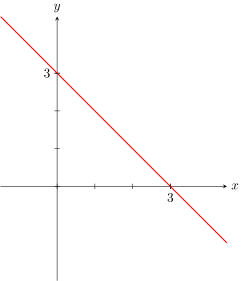
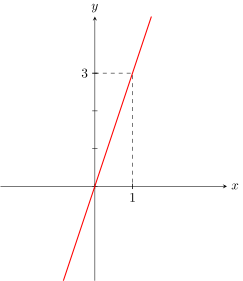
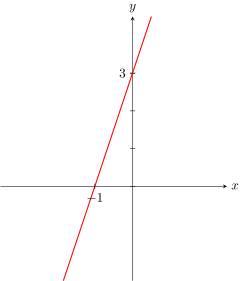
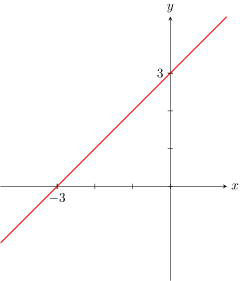
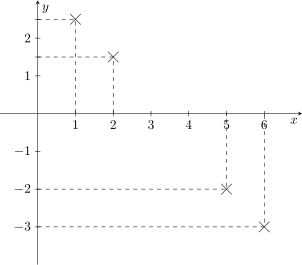
Choose the true statement.
The given points do not lay on the graph of a linear function.
The given points lay on the graph of the linear function \( f(x)=-x+3 \).
The given points lay on the graph of the linear function \( f(x)=-x+3.5 \).
The given points lay on the graph of the linear function \( f(x)=x+3 \).

1103171504

Level: 
C
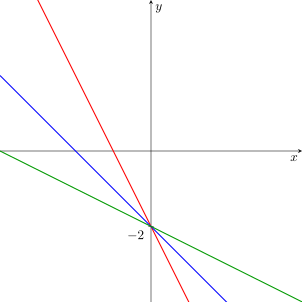
The picture shows velocity-time graphs of movements of cars \( A \), \( B \), \( C \) and \( D \). Which of the cars speeds up with constant acceleration of \( 0.8\,\frac{\mathrm{m}}{\mathrm{s}^2} \)? \[ \] Hint: An acceleration \( a \) is the rate of change of velocity \( \Delta v \) of an object with respect to time \( \Delta t \), i.e. \( a=\frac{\Delta v}{\Delta t} \).

\( A \)
\( B \)
\( C \)
\( D \)

1103171503

Level: 
C
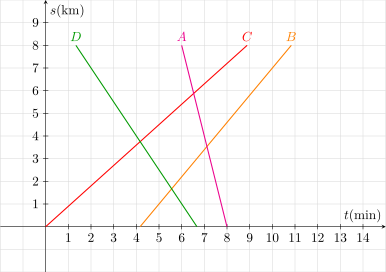
Trains run between the towns \( M \) and \( N \) in both directions. The lines in the distance-time diagram correspond to the uniform movements of trains \( A \), \( B \), \( C \) and \( D \) between the towns. Find out which of the trains is the fastest. \[ \] Note: The distance-time diagram as seen in the picture is a graphical representation of trains operating schedule for a certain rout (or routs). Connections are displayed as broken-lines or line segments in rectangular coordinate system, where horizontal is the time axis with the time during an operating day and vertical is the distance axis with distances of the traffic nodes (e.g. railroad stations, cities) from one chosen reference node (in our case the town \( N \)). Connections in one direction (from \( N \) to \( M \)) are displayed by the lines skewed to the right (trains \( B \) and \( C \)) and back-connections in other direction (from \( M \) to \( N \)) are displayed by the lines skewed to the left (trains \( A \) and \( D \)).
\( A \)
\( B \)
\( C \)
\( D \)