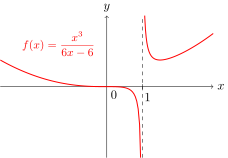
Analyzing function behavior

9000142004

Level: 
B
Identify a correct statement related to the function $f$ shown in the picture.
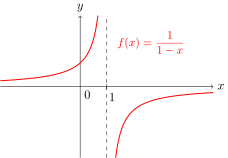
concave up on \((-\infty ;1)\), concave down on \((1;\infty )\), no inflection
concave up on \((-\infty ;1)\), concave down on \((1;\infty )\), inflection at \(x = 1\)
concave up on \((1;\infty )\), concave down on \((-\infty ;1)\), inflection at \(x = 1\)
concave up on \((1;\infty )\), concave down on \((-\infty ;1)\), no inflection
9000142005

Level: 
B
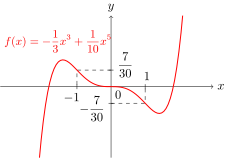
Identify a correct statement related to the function $f$ shown in the picture.
concave up on \((-1;0)\) and \((1;\infty )\), concave down on \((-\infty ;-1)\) and \((0;1)\), inflection at \(x_{1} = -1\), \(x_{2} = 0\) and \(x_{3} = 1\)
concave up on \((-1;0)\cup (1;\infty )\), concave down on \((-\infty ;-1)\cup (0;1)\), inflection at \(x_{1} = -1\), \(x_{2} = 0\) and \(x_{3} = 1\)
concave up on \((-\infty ;-1)\) and \((0;1)\), concave down on \((-1;0)\) and \((1;\infty )\), inflection at \(x_{1} = -1\), \(x_{2} = 0\) and \(x_{3} = 1\)
concave up on \((-\infty ;-1)\cup (0;1)\), concave down on \((-1;0)\cup (1;\infty )\), inflection at \(x_{1} = -1\), \(x_{2} = 0\) and \(x_{3} = 1\)

9000142006

Level: 
B
Identify a correct statement related to the function $f$ shown in the picture.
concave up on \((-\infty ;0)\) and \((1;\infty )\), concave down on \((0;1)\), a unique inflection at \(x = 0\)
concave up on \((-\infty ;0)\) and \((1;\infty )\), concave down on \((0;1)\), inflection at \(x_{1} = 0\) and \(x_{2} = 1\)
concave up on \((-\infty ;0)\cup (1;\infty )\), concave down on \((0;1)\), a unique inflection at \(x = 0\)
concave up on \((0;1)\), concave down on \((-\infty ;0)\) and \((1;\infty )\), inflection at \(x_{1} = 0\) and \(x_{2} = 1\)

9000145410

Level: 
A
Identify a true statement about the function \(f(x) = \frac{1} {4}x^{4} - x^{3}\).
The local minimum of \(f\) is at \(x = 3\).
The function \(f\) has neither local minimum nor local maximum.
The function \(f\) has a local minimum at \(x = 0\).
The function \(f\) has two local extrema. These extrema are at \(x = 3\) and \(x = 0\).

9000079106

Level: 
A
Given function \(f(x)= x\mathrm{e}^{\frac{1} {x} }\), identify a true statement.
The local minimum of the function \(f\) is at the point \(x = 1\), the function does not have a local maximum.
The local maximum of the function \(f\) is at the point \(x = 0\), the local minimum at \(x = 1\).
The local maximum of the function \(f\) is at the point \(x = 1\), the function does not have a local minimum.
The function \(f\) has neither local minimum nor maximum.

9000079101

Level: 
A
Find the intervals of monotonicity for the following function. \[ f(x)= \frac{3x + 1} {2x - 5} \]
Decreasing on \(\left (-\infty ; \frac{5} {2}\right )\) and \(\left (\frac{5} {2};\infty \right )\).
Decreasing on \(\left (-\infty ; \frac{5} {2}\right )\cup \left (\frac{5} {2};\infty \right )\).
Decreasing on \(\left (-\infty ; \frac{5} {2}\right )\), increasing on \(\left (\frac{5} {2};\infty \right )\).
Increasing on \(\left (-\infty ; \frac{5} {2}\right )\), decreasing on \(\left (\frac{5} {2};\infty \right )\).