C

9000009301

Level: 
C
An automatic machine produces \(12\) components per minute and stores them in a box with capacity \(1\: 500\) components. The machine starts with an initial amount of \(240\) components in the box. In what time will be the box full?
\(1\, \mathrm{h}\) \(45\, \mathrm{min}\)
\(1\, \mathrm{h}\) \(55\, \mathrm{min}\)
\(2\, \mathrm{h}\) \(5\, \mathrm{min}\)
\(2\, \mathrm{h}\) \(15\, \mathrm{min}\)
9000009302

Level: 
C
An automatic machine produces \(12\) components per minute and stores them in a box with capacity \(1\: 500\) components. The machine starts with an initial amount of \(240\) components in the box. In what time will the box contain \(1\: 020\) components?
\(1\, \mathrm{h}\) \(5\, \mathrm{min}\)
\(55\, \mathrm{min}\)
\(1\, \mathrm{h}\)
\(1\, \mathrm{h}\) \(10\, \mathrm{min}\)

9000007105

Level: 
C
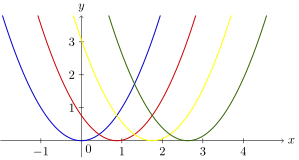
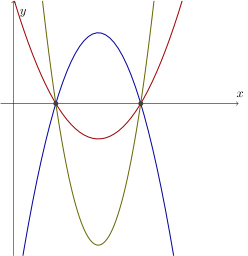
Consider a family \(M\) of quadratic functions, as shown in the picture. Any quadratic function in this family is given by the analytic expression \[ y = ax^{2} + bx + c \] where \(a\), \(b\) and \(c\) are real constants and \(a\not = 0\). For each function the set \(K\) denotes the set of \(x\)-intercepts. Complete the statement. „The analytic expressions for functions in the family \(M\) share only ....”
the solution set \(K\)
the value of the coefficient \(a\)
the value of the coefficient \(b\)
the value of the coefficient \(c\)

9000007103

Level: 
C
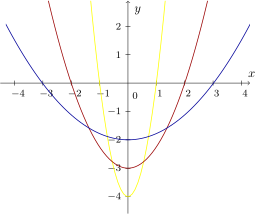
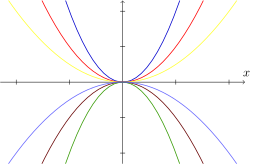
Consider a family \(M\) of quadratic functions, as shown in the picture. Any quadratic function in this family is given by the analytic expression \[ y = ax^{2} + bx + c \] where \(a\), \(b\) and \(c\) are real constants and \(a\not = 0\). For each function the set \(K\) denotes the set of \(x\)-intercepts. Complete the statement. „The analytic expressions for functions in the family \(M\) share only ....”
the value of the coefficient \(a\)
the value of the coefficient \(b\)
the value of the coefficient \(c\)
the solution set \(K\)

9000007104

Level: 
C
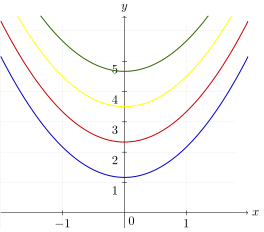
Consider a family \(M\) of quadratic functions, as shown in the picture. Any quadratic function in this family is given by the analytic expression \[ y = ax^{2} + bx + c \] where \(a\), \(b\) and \(c\) are real constants and \(a\not = 0\). For each function the set \(K\) denotes the set of \(x\)-intercepts. Complete the statement. „The analytic expressions for functions in the family \(M\) share only ....”
the value of the coefficient \(b\)
the value of the coefficient \(a\)
the value of the coefficient \(c\)
the solution set \(K\)

9000007102

Level: 
C
Consider a family \(M\) of quadratic functions, as shown in the picture. Any quadratic function in this family is given by the analytic expression \[ y = ax^{2} + bx + c \] where \(a\), \(b\) and \(c\) are real constants and \(a\not = 0\). For each function the set \(K\) denotes the set of \(x\)-intercepts. Complete the statement. „The analytic expressions for functions in the family \(M\) differ only in ....”
the coefficient \(c\)
the coefficient \(a\)
the coefficient \(b\)
the solution set \(K\)

9000007101

Level: 
C
Consider a family \(M\) of quadratic functions, as shown in the picture. Any quadratic function in this family is given by the analytic expression \[ y = ax^{2} + bx + c \] where \(a\), \(b\) and \(c\) are real constants and \(a\not = 0\). For each function the set \(K\) denotes the set of \(x\)-intercepts. Complete the statement. „The analytic expressions for functions in the family \(M\) differ only in ....”
the coefficient \(a\)
the coefficient \(b\)
the coefficient \(c\)
the set \(K\)

9000007201

Level: 
C
Consider the function \[ f(x) = [x + 2] \] defined on the domain \(\mathop{\mathrm{Dom}}(f) = (1,2)\). Find the parameters \(a\) and \(b\) in the linear function \[ g(x) = ax + b \] which ensure that the functions \(f\) and \(g\) are identical on the domain of \(f\). \[ \] Hint: The function \(y = [x]\) is a floor function: the largest integer less than or equal to \(x\). For positive \(x\) it is also called the integer part of \(x\).
\(a = 0\), \(b = 3\), \(\mathop{\mathrm{Dom}}(g) = (1,2)\)
\(a = 3\), \(b = 0\), \(\mathop{\mathrm{Dom}}(g) = (1,2)\)
\(a = 0\), \(b = 4\), \(\mathop{\mathrm{Dom}}(g) = (1,2)\)
\(a = -3\), \(b = 0\), \(\mathop{\mathrm{Dom}}(g) = (1,2)\)