C

9000020905

Level: 
C
Find the condition on the parameter \(c\in \mathbb{R}\) which ensures that the following system has a unique solution in \(\mathbb{R}\times \mathbb{R}\). \[ \begin{alignedat}{80} &x^{2} & + &y^{2} & = 2 & & & & & & \\ &x & + &c & = y & & & & & & \\\end{alignedat}\]
\(|c| = 2\)
\(|c| > 2\)
\(|c| < 2\)
\(c = 2\)

9000018010

Level: 
C
The salary of Peter has been increased by \(\$2\: 400\). The salary of Jane increased by \(3\, \%\) and this increase has been bigger than the increase of the Peter's salary. In the following list identify a possible old salary of Jane.
\(\$81\: 000\)
\(\$80\: 000\)
\(\$9\: 000\)
\(\$8\: 000\)

9000018110

Level: 
C
Consider a coil composed from a ferrite core and a wire winding. The mass of the core is \(2\, \mathrm{kg}\). The material for the wire is such that the mass of the wire of the length \(30\, \mathrm{m}\) is bigger than the mass of the wire of the length \(10\, \mathrm{m}\) together with the ferrite core. In the following list identify a possible mass of one meter of the wire.
\(110\, \mathrm{g}\)
\(100\, \mathrm{g}\)
\(0.01\, \mathrm{kg}\)
\(0.09\, \mathrm{kg}\)

9000009309

Level: 
C
The speed of a swimmer in a \(50\, \mathrm{m}\)-pool is \(0.8\, \mathrm{m}/\mathrm{s}\). How fast will he swim two pool lengths (one pool length is \(50\) meters), if he/she needs \(2\, \mathrm{s}\) to turn at the end of the pool?
\(127\, \mathrm{s}\)
\(82\, \mathrm{s}\)
\(84\, \mathrm{s}\)
\(129\, \mathrm{s}\)

9000009311

Level: 
C
The graph shows the speed of a train as a function of time. Find an analytic expression for this function.
\(v = 30 - \frac{3}{4}t,\ t\in [ 0;20] \)
\(v = 30 + \frac{3}{4}t,\ t\in [ 0;20] \)
\(v = 15 +\frac{3}{4}t,\ t\in [ 0;20] \)
\(v = 30 - \frac{4}{3}t,\ t\in [ 0;20] \)

9000009906

Level: 
C
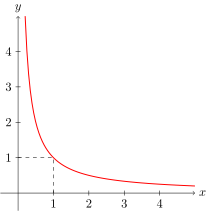
Consider a function \[ f(x) = \frac{k} {x} \] with a nonzero real parameter \(k\). Describe what happens with the function \(f\) if the coefficient \(k\) changes the sign.
The function changes the type of monotonicity on the sets \(\mathbb{R}^{+}\) and \(\mathbb{R}^{-}\) (either from an increasing function into a decreasing function or vice versa).
The function changes its parity (from an odd function into an even function or from an even function into an odd function).
The domain of the function changes.
None of the above, both functions have the same parity, monotonicity and domain.

9000009907

Level: 
C
Consider a function \[ f(x) = \frac{k} {x} \] with a nonzero real parameter \(k\). Suppose that the value of the coefficient \(k\) changes, but the sign of \(k\) remains the same. Describe which of the properties of \(f\) is changed.
None of the above, both functions have the same parity, monotonicity and range.
The function changes its parity (from an odd function into an even function or from en even function into an odd function).
The range of the function changes.
The function changes the type of monotonicity on the sets \(\mathbb{R}^{+}\) and \(\mathbb{R}^{-}\) (either from an increasing function into a decreasing function or vice versa).